News & Updates
Bank Rate at 4%: What the 0.25-Point Rise Means for Your Loan Payments
The Bank of England lifted Bank Rate to 4% on 5 November 2026. See what +0.25% adds to a £15,000 loan: £1.77 a month. Free calculator included.

Written by Ahad NoorPublished 7 min read
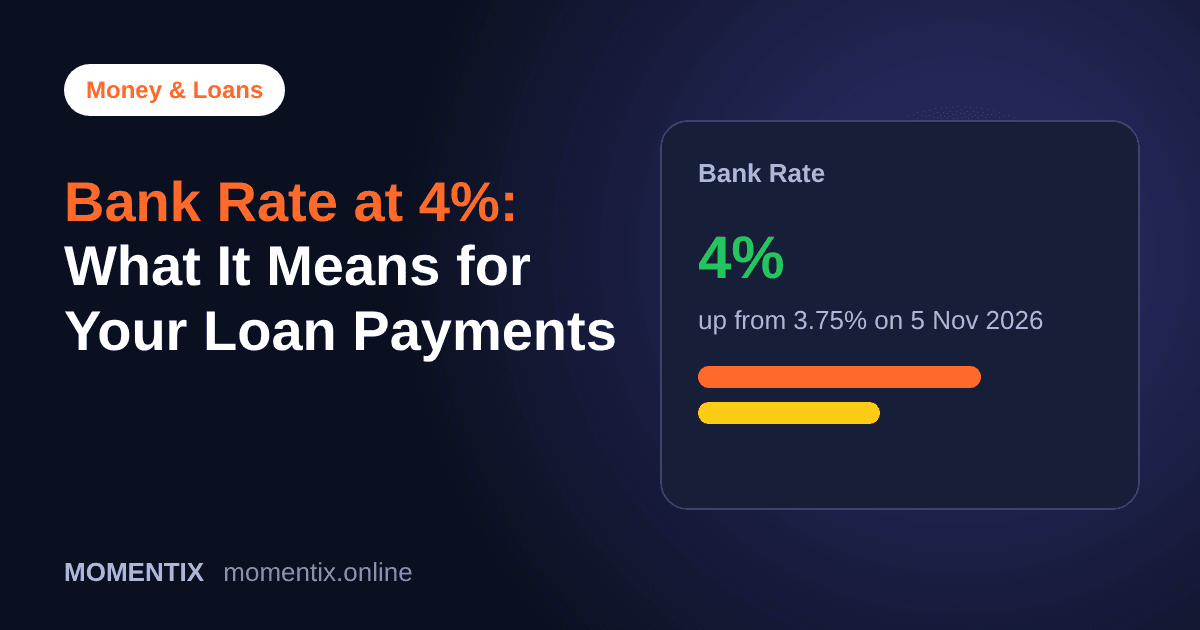
On 5 November 2026 the Bank of England raised Bank Rate by 0.25 percentage points, from 3.75% to 4%. Whether that changes what you pay depends on one thing: is your loan at a fixed rate or a variable one? A fixed rate stays as agreed for the whole term. A variable or tracker rate can move, usually after a notice period set out in your agreement.
This guide puts numbers on it. A quarter-point rise on a £15,000 five-year loan adds £1.77 a month. That is small, but it compounds across the term, and the interest you pay climbs faster than the monthly figure suggests. Every figure below comes from the same formula as the loan repayment calculator, so you can swap in your own loan.
Contents
What did the Bank of England decide?#
The Bank's Monetary Policy Committee raised Bank Rate to 4% on 5 November 2026, up from 3.75%. The Bank's own rate page lists the next announcement for 17 December 2026. Bank Rate is the rate the Bank pays on commercial bank reserves, and lenders use it as a reference point when they price loans, mortgages and savings.
It is not the rate on your loan. Your lender adds its own margin for risk, costs and profit, which is why a personal loan rate sits well above Bank Rate. What matters for you is whether your lender passes a change on, and when.
Which loans change when Bank Rate rises?#
Fixed-rate loans do not change when Bank Rate rises; variable-rate loans, overdrafts, tracker products and new borrowing can.
- Fixed-rate personal and car loans: the rate and payment are set for the whole term, so Bank Rate does not change them.
- Variable-rate loans and overdrafts: the lender can move the rate, so payments or interest can rise. Check how much notice your agreement requires.
- Tracker products: these follow Bank Rate by a set margin, so a quarter-point rise passes through in full.
- New borrowing: a new loan quote can be priced higher than one from a few weeks ago, even though nothing about you has changed.
If you are not sure which group you are in, find the 'rate' section of your credit agreement or ask your lender in writing.
How much does +0.25% add to a £15,000 loan?#
A quarter-point rise adds about £1.77 a month to a £15,000, five-year loan, and £106.35 in interest over the term.
Worked example: £15,000 over 5 years, 7% to 7.25%
Assumptions: 60 equal monthly payments, interest charged monthly, no fees, rate changes at the start.
- At 7%: payment £297.02, total interest £2,821.08.
- At 7.25%: payment £298.79, total interest £2,927.43.
- Difference: £1.77 a month, or £106.35 over the five years.
A quarter-point rise on this loan costs about the price of a takeaway each year, which is easy to absorb, and easy to ignore if it keeps happening.
Monthly payment on a fixed-rate loan
Payment = P × r ÷ (1 − (1 + r)^−n)
P = amount borrowed; r = annual rate ÷ 12; n = number of months
| Loan amount | Payment at 7% | Payment at 7.25% | Extra a month | Extra interest in total |
|---|---|---|---|---|
| £5,000 | £99.01 | £99.60 | £0.59 | £35.45 |
| £10,000 | £198.01 | £199.19 | £1.18 | £70.90 |
| £15,000 | £297.02 | £298.79 | £1.77 | £106.35 |
| £20,000 | £396.02 | £398.39 | £2.36 | £141.80 |
| £30,000 | £594.04 | £597.58 | £3.54 | £212.69 |
What if rates keep rising?#
A single quarter-point is modest. The effect of several adds up in a straight line on the payment, so you can plan for a range rather than a guess. The Bank's own page only commits to the dates of its meetings, not to a direction, so treat this as a what-if and not a forecast.
| Rate | Monthly payment | Total interest | Extra interest vs 7% |
|---|---|---|---|
| 7% | £297.02 | £2,821.08 | £0.00 |
| 7.25% | £298.79 | £2,927.43 | £106.35 |
| 7.5% | £300.57 | £3,034.15 | £213.08 |
| 7.75% | £302.35 | £3,141.26 | £320.19 |
| 8% | £304.15 | £3,248.75 | £427.68 |
Each extra quarter-point adds roughly the same amount, about £1.77 a month here. A full percentage point (7% to 8%) is £7.13 a month and £427.68 over the term.
What can you do about it?#
The most direct lever is the balance. Paying an extra £50 a month on the £15,000 loan at 7.25% cuts the term from 60 to 50 months and the interest from £2,927.43 to £2,421.98, a saving of £505.44. That more than covers the rise.
Quick checklist
- Find out whether your loan is fixed or variable, and how much notice the lender must give before changing the rate.
- Ask your lender in writing for a settlement figure if you are thinking of paying early; they must tell you the amount to clear it.
- Check whether an early repayment charge applies before you overpay.
- Use the loan calculator with the new rate to see the payment and the effect of overpaying.
- If you are comparing new quotes, compare the total cost, not just the monthly payment.
Mistake: Assuming every loan rises with Bank Rate.
Instead: Fixed-rate loans do not change during the fixed term. Only variable and tracker rates, and new borrowing, move.
Mistake: Judging a rise by the monthly payment alone.
Instead: A few pounds a month hides the total: here it adds more than a hundred pounds of interest over the term.
Mistake: Overpaying without checking the agreement.
Instead: Some agreements allow an early repayment charge, so ask for a settlement figure and any charge in writing first.
Try the tool
Loan Repayment Calculator
Enter your loan, your old rate and the new rate to see the payment difference and what extra payments would save.
Open the Loan Repayment CalculatorRelated guides: How loan repayments work, what the rise means for a mortgage, paying a loan off early.
Frequently asked questions#
Bank Rate is 4%. The Monetary Policy Committee raised it by 0.25 percentage points from 3.75% on 5 November 2026. The next announcement is scheduled for 17 December 2026.
No. A fixed rate is set for the whole term in your agreement, so a change in Bank Rate does not alter it. A variable-rate loan, an overdraft or a tracker product can change, and the amount of notice depends on your agreement.
On a five-year loan going from 7% to 7.25%, the payment rises by £1.18 a month, and total interest rises by £70.90.
It can be, because less balance means less interest at a higher rate. Check for an early repayment charge first and compare the interest saved with what you would earn elsewhere on the same money.
Ask your lender for a settlement figure in writing. They must tell you the amount needed to pay in full, and you then have 28 days from when they receive your request to pay it, according to Citizens Advice.
Sources
- Bank of England – Bank Rate (checked 9 November 2026)
- Citizens Advice – Paying off a credit agreement early (checked 9 November 2026)
Ahad Noor
Ahad Noor builds and maintains Momentix, including its calculators, converters and the guides on this blog.
Each guide is checked against the matching Momentix tool, so the worked examples show the same figures the tool gives for the same inputs.