Money & Calculations
How Loan Repayments Work: Payment, Interest and Term Explained
A £10,000 loan at 7% over 5 years costs £198.01 a month and £1,880.72 in interest. See the formula, a month-by-month table and how term and rate change it.

Written by Ahad NoorPublished 7 min read
A fixed-rate loan is repaid in equal monthly payments. Each payment covers that month’s interest first, and the rest reduces what you owe. A £10,000 loan at 7% over 5 years costs £198.01 a month, and you repay £11,880.72 in total, of which £1,880.72 is interest.
This guide explains the payment formula, shows the first and last three months of that loan so you can see the split between interest and principal change, and compares how the term and the rate move the cost. It is the starting point for the other loan guides: paying a loan off early and a £22,000 loan at different terms. All figures come from the same formulas as the loan repayment calculator.
Contents
How is a monthly loan payment calculated?#
Three numbers decide the payment: the amount borrowed, the interest rate and the number of months. The formula spreads the loan and its interest into equal payments so that the balance reaches exactly zero after the last one.
Monthly payment on a fixed-rate loan
Payment = P × r ÷ (1 − (1 + r)^−n)
P = amount borrowed, r = annual rate ÷ 12 (as a decimal), n = number of monthly payments
At a 0% rate the formula becomes simply P ÷ n.
Worked example: £10,000 at 7% over 5 years
Assumptions: Fixed rate of 7% a year, 60 monthly payments, interest charged monthly on the balance, no fees.
- Monthly rate r = 7% ÷ 12 = 0.5833%.
- Payment = £198.01 (rounded to the penny).
- Total repaid = 60 × £198.01 ≈ £11,880.72.
- Total interest = £11,880.72 − £10,000 = £1,880.72.
You pay the lender about 18.8% of the amount borrowed for the use of the money over five years.
Where each payment goes: month by month#
Every month the interest is the balance times the monthly rate. The payment minus that interest is the part that reduces the balance, known as principal. Because the balance shrinks, the interest falls and the principal grows.
| Month | Payment | Interest | Principal repaid | Balance after payment |
|---|---|---|---|---|
| 1 | £198.01 | £58.33 | £139.68 | £9,860.32 |
| 2 | £198.01 | £57.52 | £140.49 | £9,719.83 |
| 3 | £198.01 | £56.70 | £141.31 | £9,578.51 |
| 58 | £198.01 | £3.43 | £194.59 | £392.59 |
| 59 | £198.01 | £2.29 | £195.72 | £196.86 |
| 60 | £198.01 | £1.15 | £196.86 | £0.00 |
Rounding to the penny each month can move the last payment by a few pence in a real loan.
In month one, 29% of the payment (£58.33 of £198.01) is interest. In month 60 it is under 1%. This front-loading is why an extra payment in the first year saves more interest than the same payment near the end, and why settling a loan early helps most when the balance is still high.
How the term changes the cost#
A longer term spreads the loan over more payments, so each one is smaller. But the balance stays high for longer, so you pay interest for more months.
| Term | Monthly payment | Total interest | Total repaid |
|---|---|---|---|
| 3 years | £308.77 | £1,115.75 | £11,115.75 |
| 5 years | £198.01 | £1,880.72 | £11,880.72 |
| 7 years | £150.93 | £2,677.85 | £12,677.85 |
| 10 years | £116.11 | £3,933.02 | £13,933.02 |
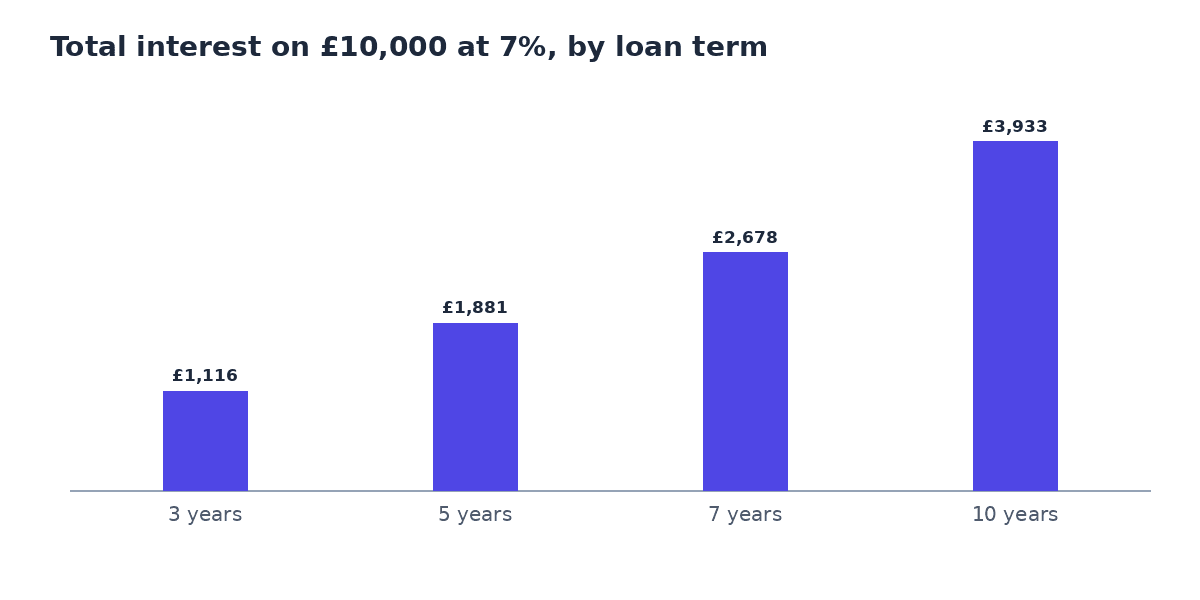
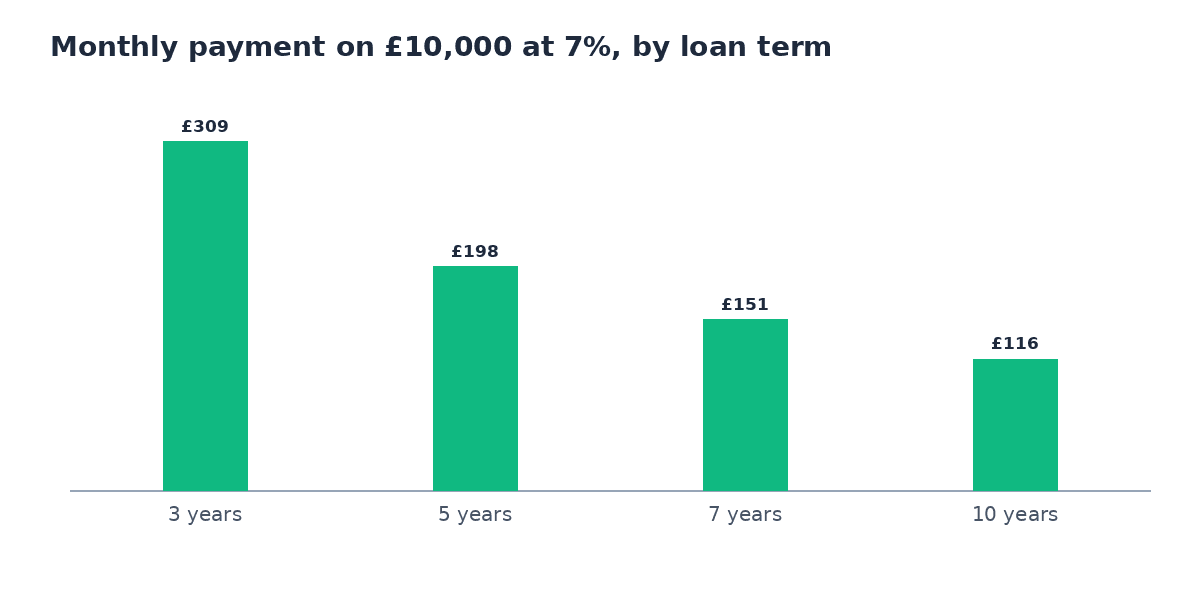
Stretching from 5 to 10 years cuts the payment by £81.90 a month but adds £2,052.30 of interest. Choosing the shortest term you can comfortably afford usually costs the least overall.
How the interest rate changes the cost#
| Annual rate | Monthly payment | Total interest | Total repaid |
|---|---|---|---|
| 5% | £188.71 | £1,322.74 | £11,322.74 |
| 7% | £198.01 | £1,880.72 | £11,880.72 |
| 9% | £207.58 | £2,455.01 | £12,455.01 |
Two points above or below the 7% example changes the monthly payment by about £10, but changes the total interest by over £550 either way. When comparing offers, compare the total cost as well as the monthly figure, and check any fees: a lender’s APR combines the rate with certain charges so that offers can be compared on the same basis.
Ways to reduce what a loan costs#
Only three levers change the cost of a fixed-rate loan: a lower rate, a shorter term, or paying more than the required amount.
- Lower rate: compare lenders, and check whether a smaller loan or a larger deposit qualifies for a better rate.
- Shorter term: a higher payment, but far less interest, as the term table shows.
- Overpayments: extra monthly payments or a lump sum cut the balance sooner. The guide How to pay off a loan early shows £100 extra a month saving £719.39 on this loan.
Before you take a loan
- Compare total cost, not only the monthly payment.
- Check the APR, any fees and whether early repayment is allowed or charged.
- Choose the shortest term whose payment fits your budget with some room to spare.
- Try the same loan at a slightly higher rate in case it changes.
- Run the numbers in the loan calculator and keep the result.
Common mistakes#
Mistake: Choosing a loan by the lowest monthly payment.
Instead: A low payment usually means a long term and more interest. £116.11 a month looks cheaper than £198.01 but costs £2,052.30 more in interest.
Mistake: Multiplying the rate by the years to estimate interest.
Instead: 7% × 5 years × £10,000 = £3,500 overstates the cost, because the balance falls as you repay. The real interest is £1,880.72.
Mistake: Ignoring fees.
Instead: Arrangement fees and insurance add to the cost without changing the rate. Compare the APR and the total amount payable.
Mistake: Assuming the first payments reduce the loan quickly.
Instead: Early payments are mostly interest (29% in month one here), so the balance falls slowly at first.
Try the tool
Loan Repayment Calculator
Enter the amount, rate and term to see the monthly payment and total interest, then add extra payments to compare.
Open the Loan Repayment CalculatorMore guides and calculators on this topic#
This guide is the overview for Loans and savings. Each guide below goes deeper on one question, and each calculator lets you try your own numbers.
- How to Pay Off a Loan Early: Interest Saved With Extra Payments
- £22,000 Loan: Monthly Payment and Total Interest at 3, 5 and 7 Years
- Compound Interest With Monthly Deposits: Worked Examples at 3%, 5% and 7%
Calculators for this topic:
Other topics: How to Calculate the Days Between Two Dates (With Examples), UK Take-Home Pay Explained for 2026/27: Tax, NI, Student Loans and Pensions, Percentages Explained: Of, Increase, Decrease and Reverse.
Frequently asked questions#
How do I calculate the monthly payment on a loan?
Use Payment = P × r ÷ (1 − (1 + r)^−n), where P is the amount borrowed, r the monthly rate and n the number of months. For £10,000 at 7% over 60 months that gives £198.01. The repayment calculator does it for any amount, rate and term.
How much interest will I pay on a £10,000 loan?
It depends on the rate and term. At 7% the interest is £1,115.75 over 3 years, £1,880.72 over 5 years and £3,933.02 over 10 years.
Why is most of my early payment interest?
Interest is charged on the whole balance, which is largest at the start. In month one of the example loan, £58.33 of the £198.01 payment is interest and £139.68 reduces the balance.
Is a shorter loan always cheaper?
In total interest, yes: a shorter term means fewer months of interest. The trade-off is a higher monthly payment, so choose the shortest term you can afford without strain.
What is the difference between the interest rate and the APR?
The interest rate is the cost of borrowing the money. The APR also includes certain fees, so it lets you compare loans on a like-for-like basis. Check your lender’s documents for what is included.
Do these figures apply to car loans and personal loans?
Yes, for fixed-rate loans repaid in equal monthly instalments. They are in pounds here, but the method and percentages are the same in any currency.
Ahad Noor
Ahad Noor builds and maintains Momentix, including its calculators, converters and the guides on this blog.
Each guide is checked against the matching Momentix tool, so the worked examples show the same figures the tool gives for the same inputs.