Money & Calculations
UK Take-Home Pay Explained for 2026/27: Tax, NI, Student Loans and Pensions
How gross pay becomes take-home pay in 2026/27: Personal Allowance, tax bands, National Insurance, student loans, pensions and a salary table to £125,140.

Written by Ahad NoorPublished 9 min read
Your take-home pay is your gross pay minus Income Tax, National Insurance and any pension or student loan deductions. In the 2026/27 tax year, in England, Wales and Northern Ireland, a £40,000 salary leaves £32,319.60 a year, or £2,693.30 a month, with no pension or student loan.
This guide explains each deduction, shows take-home pay for nine salaries up to £125,140, and explains why the amount you keep from the next £1,000 of pay changes as you earn more, falling to £380 between £100,000 and £101,000. It is the overview for the other salary guides: a £30,000 salary after tax and converting an hourly rate to a salary. Figures come from the UK take-home pay calculator and its 2026/27 rates.
Contents
What comes off your pay?#
Up to five deductions can apply. Most employees see the first two, and many see a pension as well.
- Income Tax: a percentage of pay above your Personal Allowance, charged in bands.
- National Insurance (NI): a separate percentage charged on pay above a threshold. It does not use the same bands as Income Tax.
- Pension contributions: a percentage you choose or your employer sets, usually taken before Income Tax.
- Student loan repayments: 9% of pay above your plan’s threshold (6% for a postgraduate loan).
- Other deductions: such as union fees or a season-ticket loan, which this guide does not model.
The rates used here and when they were checked#
Every figure in this guide is for the 2026/27 tax year (6 April 2026 to 5 April 2027). The rates and thresholds below are the ones stored in the calculator’s configuration, which was last checked against GOV.UK on 29 September 2026 (see Sources). Nothing else in the calculation is assumed.
| Item | Value used |
|---|---|
| Personal Allowance | £12,570 |
| Basic rate band (taxable income) | £37,700 at 20% |
| Higher rate | 40% up to £125,140 of taxable income |
| Additional rate | 45% above £125,140 |
| Allowance withdrawn from | £100,000 (£1 for every £2) |
| Employee National Insurance | 8% from £12,570 to £50,270, then 2% |
| Plan 1, 2, 4, 5 thresholds | £26,900, £29,385, £33,795, £25,000 (9% above) |
| Postgraduate Loan | 6% above £21,000 |
Recomputed check: £30,000, £50,000 and £80,000 from those rates
Assumptions: 2026/27 rates in the table above; no pension or student loan.
- £30,000: Income Tax (30,000 − 12,570) × 20% = £3,486.00; NI (30,000 − 12,570) × 8% = £1,394.40; take-home £25,119.60.
- £50,000: Income Tax (50,000 − 12,570) × 20% = £7,486.00; NI (50,000 − 12,570) × 8% = £2,994.40; take-home £39,519.60.
- £80,000: Income Tax 37,700 × 20% + (67,430 − 37,700) × 40% = £7,540.00 + £11,892.00 = £19,432.00; NI 37,700 × 8% + (80,000 − 50,270) × 2% = £3,016.00 + £594.60 = £3,610.60; take-home £56,957.40.
These match the table later in the guide and the calculator’s output.
How Income Tax works in 2026/27#
You pay no Income Tax on your first £12,570 of income, the Personal Allowance. After that, three rates apply to the slices of income above it.
| Band | Taxable income (pay minus the Personal Allowance) | Rate |
|---|---|---|
| Basic rate | The first £37,700 (so pay up to £50,270) | 20% |
| Higher rate | From £37,700 up to £125,140 | 40% |
| Additional rate | Above £125,140 | 45% |
The Personal Allowance falls by £1 for every £2 of income above £100,000 and is zero at £125,140.
Worked example: £60,000 gross
Assumptions: No pension or student loan; Personal Allowance £12,570.
- Taxable income: £60,000 − £12,570 = £47,430.
- Basic rate: £37,700 × 20% = £7,540.00.
- Higher rate: (£47,430 − £37,700) × 40% = £9,730 × 40% = £3,892.00.
- Income Tax: £7,540 + £3,892 = £11,432.00.
The 40% rate applies only to the slice above £50,270, not to the whole salary.
How National Insurance works#
In the calculator an employee pays 8% National Insurance on pay between £12,570 and £50,270, and 2% on pay above £50,270. Unlike Income Tax, it is calculated on your full pay even when a pension contribution lowers your taxable income, unless the pension is through salary sacrifice, which the calculator models separately.
Worked example: NI on £60,000
Assumptions: Employee rates 8% and 2%; thresholds £12,570 and £50,270.
- 8% band: (£50,270 − £12,570) × 8% = £37,700 × 8% = £3,016.00.
- 2% band: (£60,000 − £50,270) × 2% = £9,730 × 2% = £194.60.
- National Insurance: £3,016.00 + £194.60 = £3,210.60.
Income Tax £11,432.00 plus NI £3,210.60 leaves £45,357.40 of the £60,000.
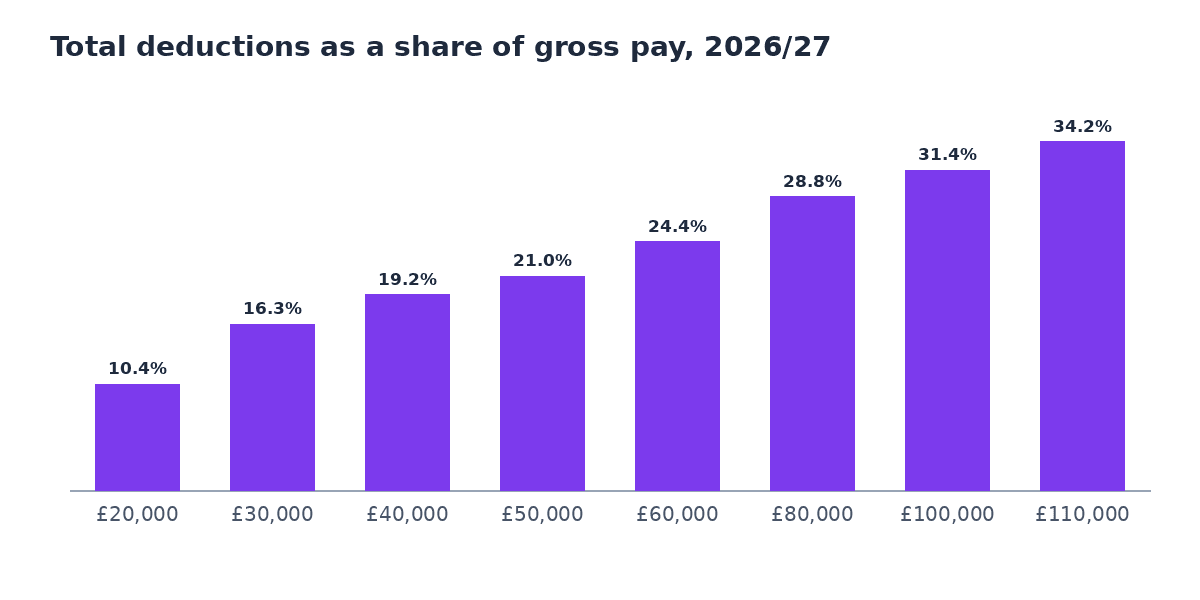
Take-home pay at nine salaries#
| Gross salary | Income Tax | National Insurance | Take-home a year | Take-home a month | Total deductions |
|---|---|---|---|---|---|
| £20,000 | £1,486.00 | £594.40 | £17,919.60 | £1,493.30 | 10.4% |
| £30,000 | £3,486.00 | £1,394.40 | £25,119.60 | £2,093.30 | 16.3% |
| £40,000 | £5,486.00 | £2,194.40 | £32,319.60 | £2,693.30 | 19.2% |
| £50,000 | £7,486.00 | £2,994.40 | £39,519.60 | £3,293.30 | 21.0% |
| £60,000 | £11,432.00 | £3,210.60 | £45,357.40 | £3,779.78 | 24.4% |
| £80,000 | £19,432.00 | £3,610.60 | £56,957.40 | £4,746.45 | 28.8% |
| £100,000 | £27,432.00 | £4,010.60 | £68,557.40 | £5,713.12 | 31.4% |
| £110,000 | £33,432.00 | £4,210.60 | £72,357.40 | £6,029.78 | 34.2% |
| £125,140 | £42,516.00 | £4,513.40 | £78,110.60 | £6,509.22 | 37.6% |
How much of the next £1,000 do you keep?#
The share you keep of each extra £1,000 depends on where you are. The table adds £1,000 to a salary and shows how much take-home pay rises.
| From → to | Extra take-home | Kept | Deducted |
|---|---|---|---|
| £30,000 → £31,000 | £720.00 | 72% | 28% |
| £60,000 → £61,000 | £580.00 | 58% | 42% |
| £100,000 → £101,000 | £380.00 | 38% | 62% |
At £30,000 the 20% basic rate and 8% NI take 28p of each extra pound. At £60,000 the 40% higher rate and 2% NI take 42p. Between £100,000 and £125,140 the Personal Allowance is withdrawn at £1 for every £2 earned, which adds an extra 20p of tax to each pound (half of the 40% rate), so with 2% NI the total is 62p.
Student loans and pensions#
A student loan repayment is 9% of pay above your plan’s threshold, and 6% above £21,000 for a postgraduate loan. Which plan you have depends on where and when you studied.
| Plan | Threshold | Yearly repayment | Take-home a year | Take-home a month |
|---|---|---|---|---|
| No student loan | – | £0.00 | £32,319.60 | £2,693.30 |
| Plan 1 | £26,900 | £1,179.00 | £31,140.60 | £2,595.05 |
| Plan 2 | £29,385 | £955.35 | £31,364.25 | £2,613.69 |
| Plan 4 (Scotland) | £33,795 | £558.45 | £31,761.15 | £2,646.76 |
| Plan 5 | £25,000 | £1,350.00 | £30,969.60 | £2,580.80 |
A postgraduate loan adds 6% of pay above £21,000: £1,140.00 on £40,000 if it is the only loan.
A workplace pension contribution is usually taken before Income Tax, so a 5% contribution on £30,000 (£1,500) lowers take-home pay by only £1,200. The £30,000 salary guide has the worked figures.
Getting an accurate figure#
To check your own take-home pay
- Use your gross yearly pay from your contract or payslip.
- Select the correct student loan plan, and tick postgraduate only if you have that loan as well.
- Enter your pension percentage and check whether it is salary sacrifice.
- Compare with your payslip and look at your tax code if the figures differ.
- Re-check each April, when thresholds and rates are updated.
Mistake: Taxing the whole salary at 40% once you pass £50,270.
Instead: Only the slice above the threshold is taxed at 40%. On £60,000, £9,730 is in the higher band.
Mistake: Forgetting National Insurance.
Instead: It is charged separately: £3,210.60 on a £60,000 salary.
Mistake: Assuming a pay rise always leaves you better off by the same share.
Instead: You keep 72p of each extra £1 at £30,000 but 38p between £100,000 and £125,140.
Mistake: Using these figures for Scottish Income Tax.
Instead: Scotland sets its own bands. Use a Scotland-specific calculator for Income Tax there.
Try the tool
UK Take-Home Pay Calculator
Enter your salary, pension and student loan plan to see tax, National Insurance and take-home pay for 2026/27.
Open the UK Take-Home Pay CalculatorMore guides and calculators on this topic#
This guide is the overview for UK tax and salary. Each guide below goes deeper on one question, and each calculator lets you try your own numbers.
- £30,000 a Year After Tax in the UK (2026/27): Monthly and Weekly Take-Home
- Hourly Rate to Annual Salary: £10 to £50 an Hour at 37.5 and 40 Hours
- How to Remove VAT from a Price: Formulas and Worked Examples
Calculators for this topic:
- Take-home pay calculator
- Hourly to Salary Calculator
- VAT Calculator
- Overtime Pay Calculator
- Freelance Rate Calculator
Other topics: How to Calculate the Days Between Two Dates (With Examples), How Loan Repayments Work: Payment, Interest and Term Explained, Percentages Explained: Of, Increase, Decrease and Reverse.
Frequently asked questions#
How much is £40,000 a year after tax in the UK?
£32,319.60 a year, or £2,693.30 a month, in 2026/27 with no pension or student loan: £5,486.00 Income Tax and £2,194.40 National Insurance are deducted.
How much tax do I pay on £60,000?
£11,432.00 Income Tax and £3,210.60 National Insurance, which leaves £45,357.40 a year or £3,779.78 a month. Only the part of your income above £50,270 is taxed at 40%.
Why do I take home so little extra between £100,000 and £125,140?
The Personal Allowance reduces by £1 for every £2 of income above £100,000. That makes the effective Income Tax rate 60% on that slice, and National Insurance adds 2%, so you keep £380 of each extra £1,000.
Does the Personal Allowance change?
It is £12,570 in the calculator for 2026/27. Rates and thresholds are reviewed each tax year, so check the official figures and the calculator’s checked-on date if you are planning around a future year.
Which student loan plan am I on?
It depends on where you studied and when you started, so check your loan statement or the official student loan guidance. The calculator supports Plan 1, Plan 2, Plan 4, Plan 5 and a postgraduate loan.
Do these figures include Scottish taxpayers?
No. Scotland sets its own Income Tax bands, which this guide and the calculator do not model. Check GOV.UK for the Scottish rates.
Sources
- GOV.UK – Income Tax rates and Personal Allowances (checked 29 September 2026)
- GOV.UK – Rates and thresholds for employers 2026 to 2027 (checked 29 September 2026)
- GOV.UK – Repaying your student loan: what you pay (checked 29 September 2026)
Ahad Noor
Ahad Noor builds and maintains Momentix, including its calculators, converters and the guides on this blog.
Each guide is checked against the matching Momentix tool, so the worked examples show the same figures the tool gives for the same inputs.