Money & Calculations
Percentages Explained: Of, Increase, Decrease and Reverse
15% of 80 is 12; 12 is 15% of 80; add 15% to 80 for 92; a 15% rise that ended at 92 started at 80. Four percentage questions, each with a worked example.

Written by Ahad NoorPublished 7 min read
Almost every percentage question is one of four types: finding a percentage of a number, finding what percentage one number is of another, working out a percentage increase or decrease, or reversing a change to find the original. Once you know which type you have, the method is short.
This guide gives one formula and one worked example for each type, a mental-maths table of common percentages, and the mistakes that cause most wrong answers. Every figure was checked with the percentage change calculator. For depth on one type, see how to calculate percentage increase and decrease and how to remove VAT from a price.
Contents
Which type of percentage question is it?#
Read the question and match it to one of four patterns. The words around the percentage tell you which.
| Type | Typical wording | Method | Example |
|---|---|---|---|
| Percentage of a number | What is 15% of 80? | number × rate ÷ 100 | 80 × 15 ÷ 100 = 12 |
| What percentage | 12 is what percent of 80? | part ÷ whole × 100 | 12 ÷ 80 × 100 = 15% |
| Increase or decrease | Add 15% to 80. Take 20% off 120. | number × (1 ± rate) | 80 × 1.15 = 92; 120 × 0.80 = 96 |
| Reverse | A price is 96 after 20% off. What was it? | result ÷ (1 ± rate) | 96 ÷ 0.80 = 120 |
The rest of the guide takes each type in turn. The percentage change calculator covers adding, taking off and the change between two numbers; the reverse percentage calculator covers the fourth type.
How do you find a percentage of a number?#
Percentage of a number
Result = number × percentage ÷ 100
Or turn the percentage into a decimal: 15% = 0.15
Worked example: 15% of 80
Assumptions: Any units.
- 15% as a decimal: 15 ÷ 100 = 0.15.
- 0.15 × 80 = 12.
15% of 80 is 12.
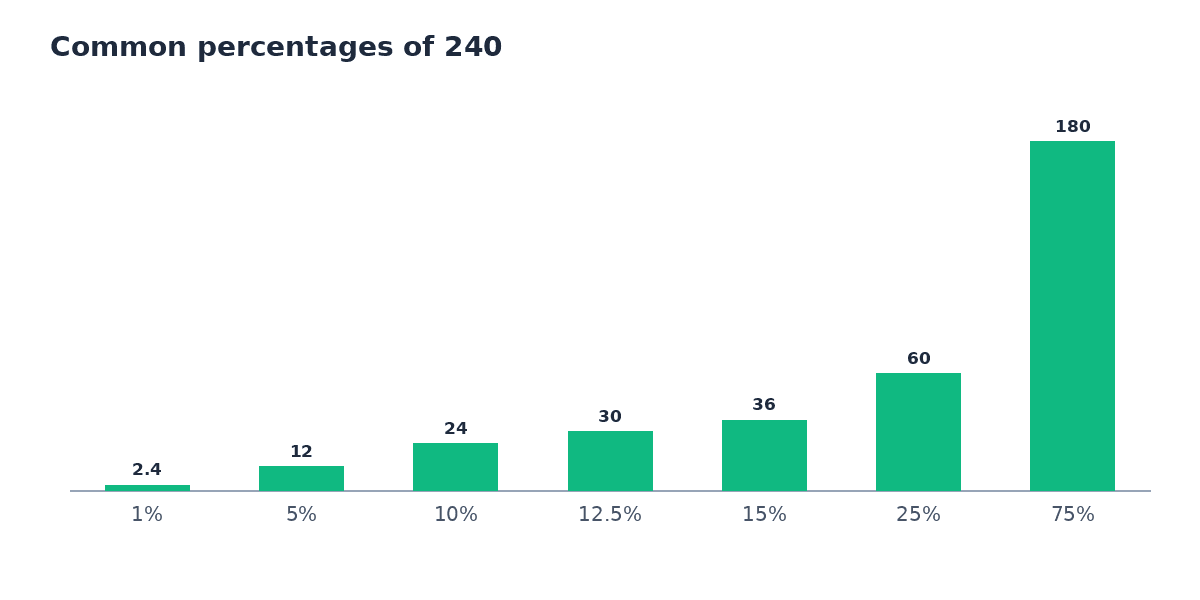
Common percentages have shortcuts. 10% is the number divided by 10, 5% is half of that, 1% is the number divided by 100, and 25% is a quarter. Combine them: 15% is 10% plus 5%.
| Percentage | How to find it | Result |
|---|---|---|
| 1% | 240 ÷ 100 | 2.4 |
| 5% | half of 10% | 12 |
| 10% | 240 ÷ 10 | 24 |
| 12.5% | one eighth: 240 ÷ 8 | 30 |
| 15% | 10% + 5% = 24 + 12 | 36 |
| 25% | one quarter: 240 ÷ 4 | 60 |
| 75% | three quarters: 3 × 60 | 180 |
How do you find what percentage one number is of another?#
Percentage that one number is of another
Percentage = part ÷ whole × 100
The whole is the number you are comparing against, the one that comes after “of”.
Worked example: 12 is what percent of 80?
Assumptions: The part is 12 and the whole is 80.
- 12 ÷ 80 = 0.15.
- 0.15 × 100 = 15%.
12 is 15% of 80. It is the reverse of the first example.
A percentage of a percentage works the same way, with the second percentage as a decimal: 20% of 15% is 0.20 × 15% = 3%.
How do you add or take off a percentage?#
You can find the change and then add or subtract it, or multiply once by a factor. The factor method is faster and works for repeated changes.
- Increase by 15%: multiply by 1.15. 80 × 1.15 = 92.
- Decrease by 20%: multiply by 0.80. 120 × 0.80 = 96.
- Percentage change between two numbers: (new − old) ÷ old × 100. From 80 to 92 that is 12 ÷ 80 × 100 = 15%.
Worked example: a sale price
Assumptions: A jacket costs 120 and is reduced by 20%.
- Saving: 120 × 0.20 = 24.
- Sale price: 120 − 24 = 96, the same as 120 × 0.80.
For several discounts in a row, use the sale price calculator: two percentage discounts do not add up to their sum.
How do you reverse a percentage change?#
If you know the price after a change and want the price before it, divide by the factor, not by subtracting the percentage again. The percentage was taken from the original, not from the result.
Worked example: the price before a 20% discount
Assumptions: The sale price is 96 after 20% off.
- The sale price is 80% of the original, so the factor is 0.80.
- Original: 96 ÷ 0.80 = 120.
- Check: 120 × 0.80 = 96. ✓
Adding 20% back to 96 would give 115.20, which is wrong; dividing by 0.80 gives the right answer.
The same idea works for a rise: a price of 92 after adding 15% was 92 ÷ 1.15 = 80. The reverse percentage calculator does this for any rate, and the VAT guide uses it to remove tax from a gross price.
Common mistakes#
Before you finish a percentage calculation
- Say which of the four types the question is.
- Identify the whole: it comes after “of” or is the starting value.
- Check the answer is sensible: 15% of 80 must be less than 80 and more than 8.
- For repeated changes, multiply the factors rather than adding the percentages.
- Round only at the end.
Mistake: Adding a percentage back to reverse a discount.
Instead: 96 + 20% is 115.20, not 120. Divide by 0.80 to undo a 20% reduction.
Mistake: Using the wrong whole.
Instead: 12 is 15% of 80, but 80 is 666.7% of 12. Always divide the part by the number that follows “of”.
Mistake: Adding successive percentages.
Instead: A 20% rise then a 20% fall is × 1.2 × 0.8 = × 0.96, a 4% fall overall, not 0%.
Mistake: Mixing percentage points and percent.
Instead: A rate rising from 4% to 5% is up 1 percentage point, but a 25% relative increase.
Try the tool
Percentage Change Calculator
Find the percentage change between two numbers, or add and take off a percentage, with every step shown.
Open the Percentage Change CalculatorMore guides and calculators on this topic#
This guide is the overview for Percentages and maths. Each guide below goes deeper on one question, and each calculator lets you try your own numbers.
Calculators for this topic:
Other topics: How to Calculate the Days Between Two Dates (With Examples), How Loan Repayments Work: Payment, Interest and Term Explained, UK Take-Home Pay Explained for 2026/27: Tax, NI, Student Loans and Pensions.
Frequently asked questions#
How do I calculate 15% of a number?
Multiply the number by 0.15. For 80 that is 12. A shortcut: find 10% by dividing by 10 (8), find 5% by halving it (4), and add them: 12.
How do I find what percentage one number is of another?
Divide the part by the whole and multiply by 100. 12 out of 80 is 12 ÷ 80 × 100 = 15%.
How do I add a percentage to a number?
Multiply by 1 plus the rate. To add 15% to 80, calculate 80 × 1.15 = 92. To take off 15%, multiply by 0.85.
How do I work out the original price before a discount?
Divide the sale price by 1 minus the discount rate. A price of 96 after 20% off was 96 ÷ 0.80 = 120. Do not add 20% back to the sale price.
What is 20% of 15%?
3%. Multiply the two as decimals: 0.20 × 0.15 = 0.03.
How do I calculate the percentage change between two numbers?
Subtract the old value from the new one, divide by the old value and multiply by 100. From 80 to 92 that is 15%. A negative result is a decrease.
Ahad Noor
Ahad Noor builds and maintains Momentix, including its calculators, converters and the guides on this blog.
Each guide is checked against the matching Momentix tool, so the worked examples show the same figures the tool gives for the same inputs.