Money & Calculations
£30,000 a Year After Tax in the UK (2026/27): Monthly and Weekly Take-Home
A £30,000 salary gives £25,119.60 a year after tax and National Insurance in 2026/27: £2,093.30 a month. See pension and student loan effects.

Written by Ahad NoorPublished 7 min read
A £30,000 salary in England, Wales or Northern Ireland leaves you with £25,119.60 a year after Income Tax and National Insurance in the 2026/27 tax year. That is £2,093.30 a month or about £483.07 a week, assuming no pension contribution and no student loan.
This guide shows where each deduction comes from, compares £30,000 with five other salaries, and explains what a workplace pension or a student loan does to the figure. The numbers come from the same formulas as the UK take-home pay calculator, using the rates it holds for 2026/27.
Contents
How much is £30,000 a year after tax?#
Two deductions apply to most employees on this salary: Income Tax and National Insurance. Both are worked out on the part of your pay above £12,570, so the first £12,570 is untouched by either.
Worked example: £30,000 gross, England, no pension, no student loan
Assumptions: Tax year 2026/27, Personal Allowance £12,570, basic rate 20%, employee National Insurance 8% between £12,570 and £50,270.
- Taxable pay: £30,000 − £12,570 = £17,430.
- Income Tax: £17,430 × 20% = £3,486.00.
- National Insurance: (£30,000 − £12,570) × 8% = £1,394.40.
- Take-home: £30,000 − £3,486.00 − £1,394.40 = £25,119.60 a year.
- Per month: £25,119.60 ÷ 12 = £2,093.30. Per week: £25,119.60 ÷ 52 = £483.07.
Total deductions are £4,880.40, an effective rate of 16.3% of gross pay.
Take-home pay (no pension or student loan)
Income Tax = (gross − Personal Allowance) × tax rate
National Insurance = (gross − NI threshold) × NI rate
Take-home = gross − Income Tax − National Insurance
Above £50,270 the rates change: 40% Income Tax and 2% National Insurance on the slice above the upper limit.
Take-home pay at £20,000 to £50,000#
The table shows the same calculation for six salaries so you can see how take-home pay grows. Each extra £5,000 of gross pay adds £3,600 of take-home pay in this range, because 28% (20% tax plus 8% National Insurance) comes off every pound above the threshold.
| Gross salary | Income Tax | National Insurance | Take-home a year | Take-home a month | Take-home a week |
|---|---|---|---|---|---|
| £20,000 | £1,486.00 | £594.40 | £17,919.60 | £1,493.30 | £344.61 |
| £25,000 | £2,486.00 | £994.40 | £21,519.60 | £1,793.30 | £413.84 |
| £30,000 | £3,486.00 | £1,394.40 | £25,119.60 | £2,093.30 | £483.07 |
| £35,000 | £4,486.00 | £1,794.40 | £28,719.60 | £2,393.30 | £552.30 |
| £40,000 | £5,486.00 | £2,194.40 | £32,319.60 | £2,693.30 | £621.53 |
| £50,000 | £7,486.00 | £2,994.40 | £39,519.60 | £3,293.30 | £759.99 |
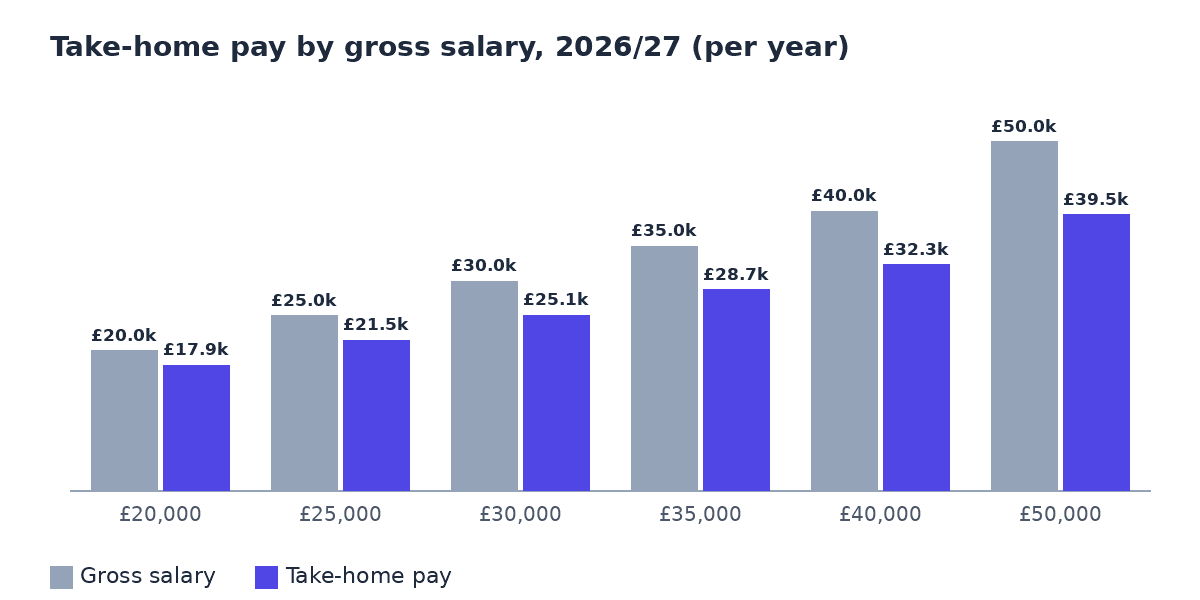
The monthly column divides the yearly figure by 12. If you are paid weekly or every four weeks, your payslip may differ slightly from these averages because tax is calculated period by period.
What a pension or student loan does to £30,000#
Two common extras change the result. The calculator models both, so you can see the effect before you check a payslip.
| Scenario | Income Tax | National Insurance | Other deduction | Take-home a year | Take-home a month |
|---|---|---|---|---|---|
| No pension, no student loan | £3,486.00 | £1,394.40 | £0.00 | £25,119.60 | £2,093.30 |
| 5% pension (£1,500 paid in) | £3,186.00 | £1,394.40 | £1,500.00 pension | £23,919.60 | £1,993.30 |
| Plan 2 student loan | £3,486.00 | £1,394.40 | £55.35 loan | £25,064.25 | £2,088.69 |
A 5% contribution is £1,500 a year, but your take-home pay falls by only £1,200. The contribution is paid out of pay before Income Tax is calculated, so you save 20% of it in tax (£300). National Insurance is still worked out on your full salary in this model, so it does not change.
A Plan 2 student loan takes 9% of earnings above its repayment threshold, which the calculator holds as £29,385. At £30,000 that is 9% of £615, or £55.35 a year, a very small amount at this salary. It grows quickly as pay rises.
Why your payslip might not match#
Several things move a real payslip away from a calculator:
- Tax code. A code other than the standard one changes how much allowance you get, for example after a second job, company car or underpaid tax.
- Pay period. Tax and National Insurance are worked out each pay period, so a bonus or an irregular month can change that month’s deductions.
- Pension type. Salary sacrifice also lowers the pay National Insurance is charged on, which the calculator can model separately. A relief-at-source scheme works differently again.
- Other deductions. Union fees, season ticket loans and Student Loan plans other than the one you chose all change the figure.
To get your most accurate figure
- Use your actual gross pay for the year, not a monthly figure multiplied by 12 if your pay varies.
- Choose the right student loan plan and tick postgraduate loan only if you have one.
- Enter your pension percentage from your payslip, and check whether your scheme uses salary sacrifice.
- Compare with your last payslip and look for differences in tax code or other deductions.
Common mistakes when working out take-home pay#
Mistake: Taking 20% off the whole £30,000.
Instead: The first £12,570 is not taxed. Only the £17,430 above it is charged at 20%, which is why Income Tax is £3,486, not £6,000.
Mistake: Forgetting National Insurance.
Instead: It is a separate deduction from Income Tax. At £30,000 it is £1,394.40, which is more than a third of the Income Tax figure.
Mistake: Assuming a pension costs its full amount in take-home pay.
Instead: Because it comes out before tax, a £1,500 pension contribution reduces take-home by £1,200 at this salary.
Mistake: Using these figures for a Scottish taxpayer.
Instead: Scotland sets its own Income Tax bands. Use a Scotland-specific calculator for your figure.
Try the tool
UK Take-Home Pay Calculator
Enter any salary to see tax, National Insurance, pension and student loan worked out for 2026/27.
Open the UK Take-Home Pay CalculatorFrequently asked questions#
How much is £30,000 a year per month after tax?
£2,093.30 a month in the 2026/27 tax year, with no pension and no student loan. That is £25,119.60 a year divided by 12, after £3,486.00 Income Tax and £1,394.40 National Insurance.
How much is £30,000 a year per week after tax?
About £483.07 a week, which is £25,119.60 divided by 52. Your actual weekly payslip varies a little because deductions are calculated for each pay period.
What is the hourly rate for a £30,000 salary?
Before tax it is about £15.38 an hour on a 37.5-hour week for 52 weeks (£30,000 ÷ 1,950 hours), or £14.42 an hour on a 40-hour week. The hourly to salary calculator converts in both directions for any hours.
How much tax do I pay on £30,000 in the UK?
£3,486.00 Income Tax plus £1,394.40 National Insurance in 2026/27, for a total of £4,880.40 or 16.3% of gross pay. This applies to England, Wales and Northern Ireland.
Does a pension reduce my take-home pay by the full amount?
No. A contribution deducted before tax gets Income Tax relief, so a £1,500 pension contribution lowers take-home pay by £1,200 on a £30,000 salary. The saving is 20% of the contribution at this income.
How does the Personal Allowance work?
It is the amount you can earn each year before paying Income Tax, £12,570 in the calculator for 2026/27. It starts to reduce for incomes over £100,000, so it does not affect a £30,000 salary.
Sources
- GOV.UK – Income Tax rates and Personal Allowances (checked 29 September 2026)
- GOV.UK – Rates and thresholds for employers 2026 to 2027 (checked 29 September 2026)
- GOV.UK – Repaying your student loan: what you pay (checked 29 September 2026)
Ahad Noor
Ahad Noor builds and maintains Momentix, including its calculators, converters and the guides on this blog.
Each guide is checked against the matching Momentix tool, so the worked examples show the same figures the tool gives for the same inputs.