Freelancing & Business
Hourly Rate to Annual Salary: £10 to £50 an Hour at 37.5 and 40 Hours
£20 an hour is £39,000 a year at 37.5 hours a week or £41,600 at 40. Formula, a £10–£50 table, and how unpaid holidays change the answer.

Written by Ahad NoorPublished 6 min read

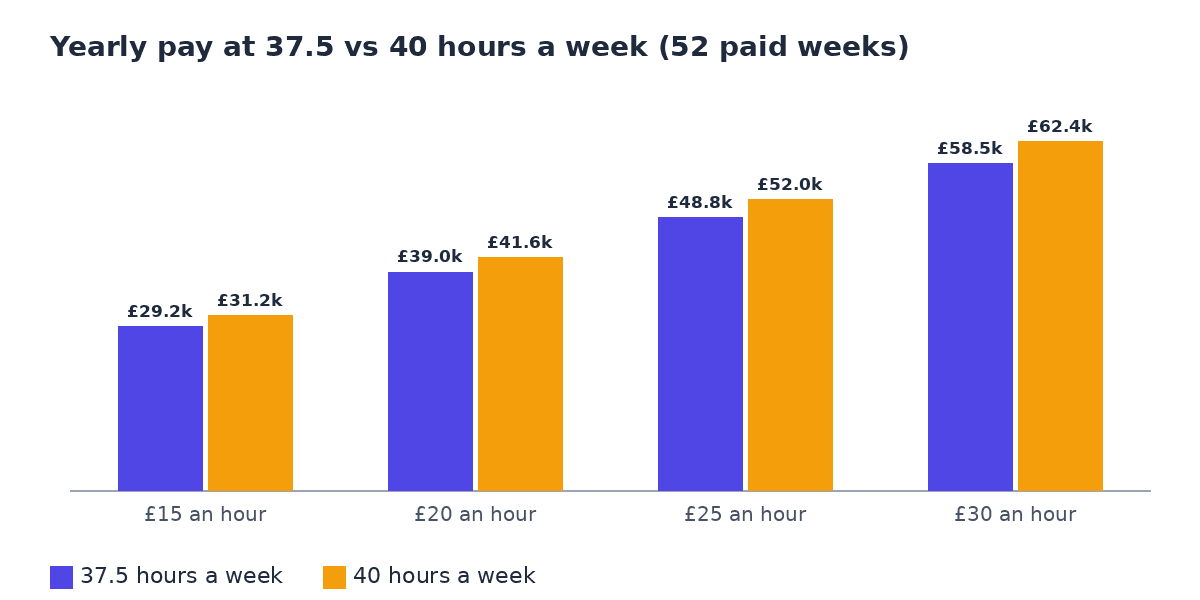
To turn an hourly rate into an annual salary, multiply it by the hours you work each week and by the number of paid weeks in the year. At £20 an hour, 37.5 hours a week and 52 paid weeks, the answer is £39,000 before tax. At 40 hours a week the same rate gives £41,600.
The hours you choose matter as much as the rate, and many online tables quietly assume 40. This guide gives the formula, a table from £10 to £50 an hour at both week lengths, and the adjustment for unpaid holidays or gaps between contracts. All figures match the hourly to salary calculator.
Contents
How do you convert an hourly rate to an annual salary?#
Hourly rate to annual salary
Annual pay = hourly rate × hours per week × paid weeks per year
Monthly pay = annual pay ÷ 12
Weekly pay = annual pay ÷ paid weeks per year
Monthly pay divides the year by 12, not by 4 weeks, because a month is on average 4.33 weeks.
Worked example: £20 an hour, 37.5 hours, 52 weeks
Assumptions: Gross pay before tax; every week of the year is paid, including holidays.
- Hours per year: 37.5 × 52 = 1,950.
- Annual pay: £20 × 1,950 = £39,000.
- Monthly pay: £39,000 ÷ 12 = £3,250.00.
- Daily pay on a 7.5-hour day: £20 × 7.5 = £150.
The same rate at 40 hours a week gives £20 × 2,080 = £41,600, which is £2,600 more.
Hourly rate to salary table: £10 to £50 an hour#
The first four columns assume 52 paid weeks. The last column shows a freelancer-style year of 46 paid weeks at 37.5 hours, to allow for holidays, sickness and gaps between work.
| Hourly rate | Yearly at 37.5 h × 52 wk | Monthly at 37.5 h | Yearly at 40 h × 52 wk | Yearly at 37.5 h × 46 wk |
|---|---|---|---|---|
| £10 | £19,500 | £1,625.00 | £20,800 | £17,250 |
| £12 | £23,400 | £1,950.00 | £24,960 | £20,700 |
| £15 | £29,250 | £2,437.50 | £31,200 | £25,875 |
| £18 | £35,100 | £2,925.00 | £37,440 | £31,050 |
| £20 | £39,000 | £3,250.00 | £41,600 | £34,500 |
| £25 | £48,750 | £4,062.50 | £52,000 | £43,125 |
| £30 | £58,500 | £4,875.00 | £62,400 | £51,750 |
| £40 | £78,000 | £6,500.00 | £83,200 | £69,000 |
| £50 | £97,500 | £8,125.00 | £104,000 | £86,250 |
If your contract says 35 hours, 37.5 hours or 40 hours, use that number. A quoted salary of £39,000 and an hourly rate of £20 describe the same job only if the week is 37.5 hours long.
How do you convert a salary to an hourly rate?#
Reverse the formula: divide the annual salary by the hours worked in a year.
| Annual salary | Hourly at 37.5 h a week | Hourly at 40 h a week |
|---|---|---|
| £25,000 | £12.82 | £12.02 |
| £30,000 | £15.38 | £14.42 |
| £45,000 | £23.08 | £21.63 |
| £60,000 | £30.77 | £28.85 |
The gap between the columns is a reminder that “what is that salary per hour?” has no single answer. A job that expects 40 hours pays less per hour than one on 37.5 hours at the same salary, so compare jobs by hours worked as well as by the headline figure.
Unpaid holidays, freelancing and the 46-week year#
Multiplying by 52 assumes every week is paid. That is true for most employees, who get paid holiday. It is not true if you are self-employed, on a zero-hours contract with no holiday pay, or you take unpaid time off.
Worked example: the same £30 an hour with 46 paid weeks
Assumptions: 37.5 hours a week; 6 weeks a year are unpaid or unbilled.
- 52 paid weeks: £30 × 37.5 × 52 = £58,500.
- 46 paid weeks: £30 × 37.5 × 46 = £51,750.
- Difference: £6,750 a year.
Six unpaid weeks cost £6,750, which is why a freelancer needs a higher hourly rate than an employee on the same target income.
To price your own work, the freelance rate calculator starts from the income you want and works backwards through billable hours, expenses and tax. For extra hours at a higher rate, use the overtime pay calculator.
From gross hourly pay to what you take home#
Every figure above is gross: it is before tax, National Insurance, pension and any student loan. To see the amount that reaches your bank account, take the annual figure to the Take-home pay calculator. For example, £20 an hour at 37.5 hours is £39,000 gross, which the calculator turns into a net figure after deductions.
Before you rely on an hourly-to-salary conversion
- Use the hours in your contract, not a default of 40.
- Decide how many weeks are paid: 52 with paid holiday, fewer without.
- Remember the figure is gross, then check take-home pay separately.
- If hours vary, use your average over the last 3 to 6 months.
Common mistakes#
Mistake: Multiplying the weekly pay by 4 to get monthly pay.
Instead: A year has 52 weeks, not 48. £20 × 37.5 × 4 = £3,000 understates the monthly figure; £39,000 ÷ 12 = £3,250 is correct.
Mistake: Using 40 hours because that is what most websites assume.
Instead: Use your contract. At £20 an hour, 40 instead of 37.5 hours overstates annual pay by £2,600.
Mistake: Treating gross hourly pay as take-home pay.
Instead: Income Tax and National Insurance come off before you are paid. Check the net figure with a take-home calculator.
Mistake: Counting 52 paid weeks when some time is unpaid.
Instead: Use only the weeks you are paid. Six unpaid weeks at £30 an hour is £6,750 less.
Try the tool
Hourly to Salary Calculator
Convert an hourly rate to yearly, monthly and weekly pay for your own hours and paid weeks, or turn a salary back into an hourly rate.
Open the Hourly to Salary CalculatorFrequently asked questions#
How much is £20 an hour per year?
£39,000 a year at 37.5 hours a week for 52 weeks, or £41,600 at 40 hours a week. Both are before tax. The monthly equivalents are £3,250.00 and £3,466.67.
How many working hours are in a year?
1,950 hours at 37.5 hours a week and 2,080 hours at 40 hours a week, for 52 paid weeks. Subtract unpaid weeks to find your own total.
How do I convert a £30,000 salary to an hourly rate?
Divide by the hours worked in a year: £30,000 ÷ 1,950 = £15.38 an hour at 37.5 hours a week, or £30,000 ÷ 2,080 = £14.42 at 40 hours a week.
Why is my monthly pay not weekly pay times four?
A year has 52 weeks, which is 4.33 weeks a month on average. Weekly pay times 52, divided by 12, gives the monthly figure. Multiplying by 4 misses about 4 weeks of pay a year.
What is the daily rate for £20 an hour?
£150 for a 7.5-hour day and £160 for an 8-hour day. A day rate is simply the hourly rate times the hours in your working day.
Should freelancers use 52 weeks?
No. Subtract holidays, sickness and unbilled time. A common approach is to plan on fewer paid weeks, such as 46, and to charge a higher hourly rate to make up the difference.
Ahad Noor
Ahad Noor builds and maintains Momentix, including its calculators, converters and the guides on this blog.
Each guide is checked against the matching Momentix tool, so the worked examples show the same figures the tool gives for the same inputs.