Money & Calculations
How to Pay Off a Loan Early: Interest Saved With Extra Payments
Paying £100 extra a month on a £10,000 loan at 7% saves £719.39 in interest and 22 months. Worked examples for overpayments and lump sums.

Written by Ahad NoorPublished 8 min read
Paying a loan off early saves interest because interest is charged on the balance you still owe. Every pound you repay sooner stops earning the lender interest for the rest of the term. On a £10,000 loan at 7% over five years, paying £100 extra each month saves £719.39 in interest and finishes the loan 22 months early.
This guide works through that example and five more, so you can see how much a monthly overpayment or a one-off lump sum changes the total cost. It also covers the checks to make before you pay, such as early repayment charges, and how to decide which of two loans to attack first. Every figure was produced with the same formulas as the loan repayment calculator.
Contents
Why paying a loan off early saves interest#
A standard repayment loan charges interest every month on the balance still owed. Your fixed monthly payment first covers that month’s interest and the rest reduces the balance. Early in the loan most of the payment is interest; later most of it reduces the balance.
An extra payment goes entirely to the balance. A lower balance means less interest next month, and a smaller interest bill means more of your normal payment reduces the balance after that. The effect compounds in your favour, which is why a small monthly overpayment shortens a loan by more than the extra money alone would suggest.
The baseline: a £10,000 loan at 7% over 5 years
Assumptions: Fixed rate 7% a year, 60 equal monthly payments, no fees, interest charged monthly on the balance.
- Monthly payment: £198.01.
- Total interest over 60 months: £1,880.72.
- Total repaid: £10,000 + £1,880.72 = £11,880.72.
Every comparison below is measured against this baseline.
Monthly payment on a fixed-rate loan
Payment = P × r ÷ (1 − (1 + r)^−n)
P = amount borrowed, r = monthly rate (annual rate ÷ 12), n = number of monthly payments
Overpayments do not change this payment; they change how quickly the balance reaches zero.
How much do extra monthly payments save?#
The table keeps the same £10,000, 7%, five-year loan and adds a fixed extra amount to every monthly payment. The standard payment stays at £198.01, and the extra is paid on top.
| Extra each month | Months to repay | Total interest | Interest saved | Time saved |
|---|---|---|---|---|
| None | 60 | £1,880.72 | £0.00 | 0 months |
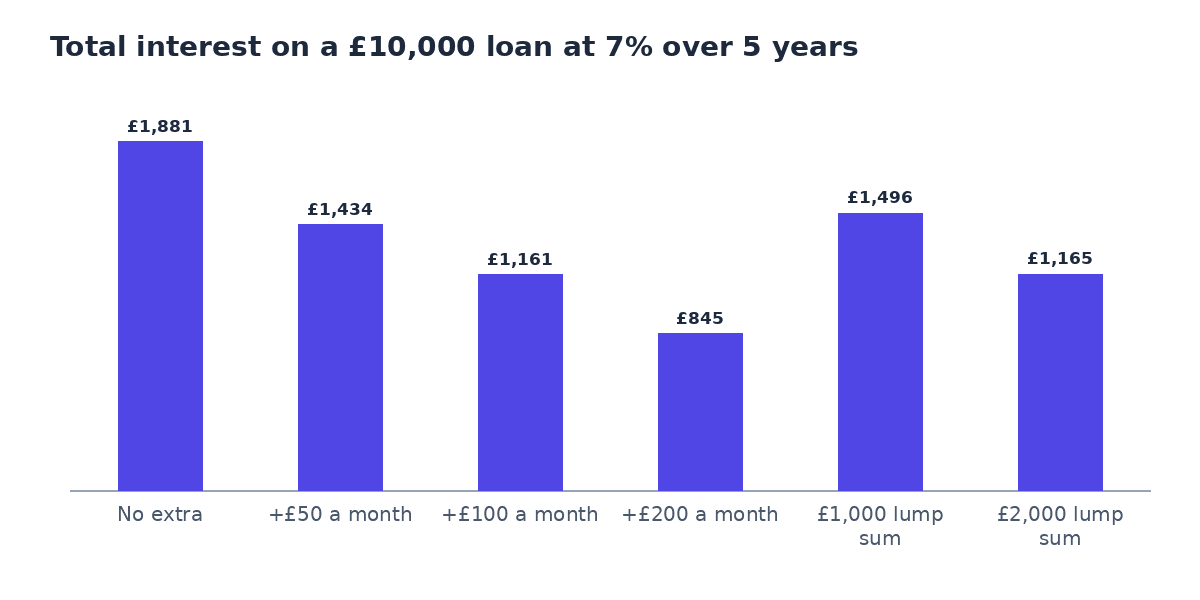
| £50 | 47 | £1,433.86 | £446.86 | 13 months |
| £100 | 38 | £1,161.33 | £719.39 | 22 months |
| £200 | 28 | £845.06 | £1,035.66 | 32 months |
Doubling the extra payment from £100 to £200 saves £316.27 more, not double: each additional pound has less balance left to work on.
Read the £100 row as a decision. You pay £100 more each month for 38 months, which is about £3,800 of extra cash, and in exchange you stop 22 months early and avoid £719.39 of interest. Whether that is worth it depends on what else the money could do, and on any charge for settling early.
Lump sum or monthly overpayments: which saves more?#
A lump sum works on the whole balance at once, so the earlier it lands the more it saves. The calculator applies a lump sum in the first month, which is the best case. The same amount paid in year three saves less, because the interest on that part of the balance has already been charged.
| Plan | Months to repay | Total interest | Interest saved | Time saved |
|---|---|---|---|---|
| £1,000 lump sum | 54 | £1,495.77 | £384.95 | 6 months |
| £2,000 lump sum | 47 | £1,165.08 | £715.64 | 13 months |
| £100 a month extra | 38 | £1,161.33 | £719.39 | 22 months |
| £1,000 lump sum + £100 a month | 34 | £936.30 | £944.42 | 26 months |
The £2,000 lump sum and the £100 monthly overpayment save almost the same interest (£715.64 against £719.39), but the monthly plan takes about £3,800 of cash over 38 months while the lump sum takes £2,000 at once. If you have the money now, paying it now is the cheaper route. If you only have spare cash each month, a regular overpayment captures most of the benefit.
Worked example: £1,000 now plus £100 a month
Assumptions: £10,000 at 7% over 5 years; lump sum in month 1; extra £100 every month.
- Standard schedule: 60 months, £1,880.72 interest.
- With both: 34 months, £936.30 interest.
- Saved: £1,880.72 − £936.30 = £944.42, and 26 months.
The two methods stack, but the saving is less than the sum of the separate savings (£384.95 + £719.39 = £1,104.34) because each one reduces the balance the other works on.
Which loan should you pay off first?#
With more than one loan, an extra pound saves the most interest on the loan with the highest interest rate. The calculator models one loan at a time, so run each loan separately with the same extra payment and compare the interest saved.
| Loan | Standard payment | Interest, no extra | Interest with £100 extra | Interest saved | Months saved |
|---|---|---|---|---|---|
| 20% a year | £111.49 | £1,013.67 | £451.59 | £562.08 | 19 |
| 5% a year | £89.91 | £236.86 | £109.84 | £127.02 | 19 |
Both loans finish 19 months early, but the 20% loan saves £562.08 in interest against £127.02 on the 5% loan. Attacking the highest rate first is called the avalanche method. Clearing the smallest balance first, the snowball method, costs a little more interest but removes a whole payment sooner, which some people find easier to keep up.
What to check before you overpay#
The arithmetic assumes every extra pound reduces your balance and costs nothing to apply. Real loans have rules, so check these before you pay:
Before making an overpayment
- Ask the lender for a settlement figure if you plan to close the loan, and check whether an early repayment charge or fee applies.
- Check the loan agreement for a limit on overpayments or a rule that they must be made in a particular way.
- Confirm the extra goes towards the balance, not towards your next scheduled payments, so the term really shortens.
- Keep an emergency fund. Money sent to a loan cannot easily be taken back out.
- Compare the loan’s rate with what your savings earn. Overpaying a 7% loan beats a 4% savings account; overpaying a 3% loan may not.
Common mistakes when paying a loan off early#
Mistake: Sending extra money without telling the lender how to apply it.
Instead: Ask for it to be applied to the balance. Some lenders treat it as an early payment of future instalments, which does not cut interest the same way.
Mistake: Comparing total interest saved without counting the cash paid.
Instead: Look at both: £719.39 saved for about £3,800 of extra payments is a different decision from £715.64 saved for a £2,000 lump sum.
Mistake: Draining savings to clear a low-rate loan.
Instead: Keep a cushion, and put extra money into the highest-rate debt first.
Mistake: Forgetting that the saving shrinks the later you start.
Instead: Most interest is charged early in the loan, so an overpayment in the first year saves far more than the same one in the last year.
Try the tool
Loan Repayment Calculator
Add extra monthly payments or a lump sum and compare payoff dates and total interest against your standard schedule.
Open the Loan Repayment CalculatorFrequently asked questions#
How do I calculate how much interest I save by paying a loan off early?
Work out the total interest on the normal schedule, work it out again with the extra payments, and subtract. For a £10,000 loan at 7% over five years that is £1,880.72 − £1,161.33 = £719.39 with £100 extra a month. The repayment calculator does both schedules and shows the difference.
Is it better to make a lump sum payment or pay extra every month?
If you have the money now, a lump sum saves more per pound because it lowers the balance for longer. A £2,000 lump sum in month one saves £715.64 on the example loan; spreading £2,000 over 20 months at £100 a month saves less. If you can only spare money monthly, regular overpayments still work well.
What is a settlement figure?
It is the exact amount a lender asks for to close the loan on a particular date, usually the remaining balance plus interest to that day and sometimes a fee. Ask for one in writing before you pay a large lump sum.
Should I pay off a loan or save the money?
Compare the loan’s interest rate with the interest your savings earn, after any tax. Paying off a loan is a guaranteed return equal to its rate. If the loan costs 7% and your savings earn 4%, clearing the loan is the better use, once you have an emergency fund.
Do these figures work for car loans and personal loans in other currencies?
Yes, for any fixed-rate loan repaid in equal monthly instalments. The figures here are in pounds, but the percentages and the months saved are the same in any currency.
Ahad Noor
Ahad Noor builds and maintains Momentix, including its calculators, converters and the guides on this blog.
Each guide is checked against the matching Momentix tool, so the worked examples show the same figures the tool gives for the same inputs.