Money & Calculations
Compound Interest With Monthly Deposits: Worked Examples at 3%, 5% and 7%
Saving £200 a month at 7% for 20 years grows to £104,185 on £48,000 paid in. Formula, a 3%/5%/7% table and why starting early beats saving more.

Written by Ahad NoorPublished 7 min read
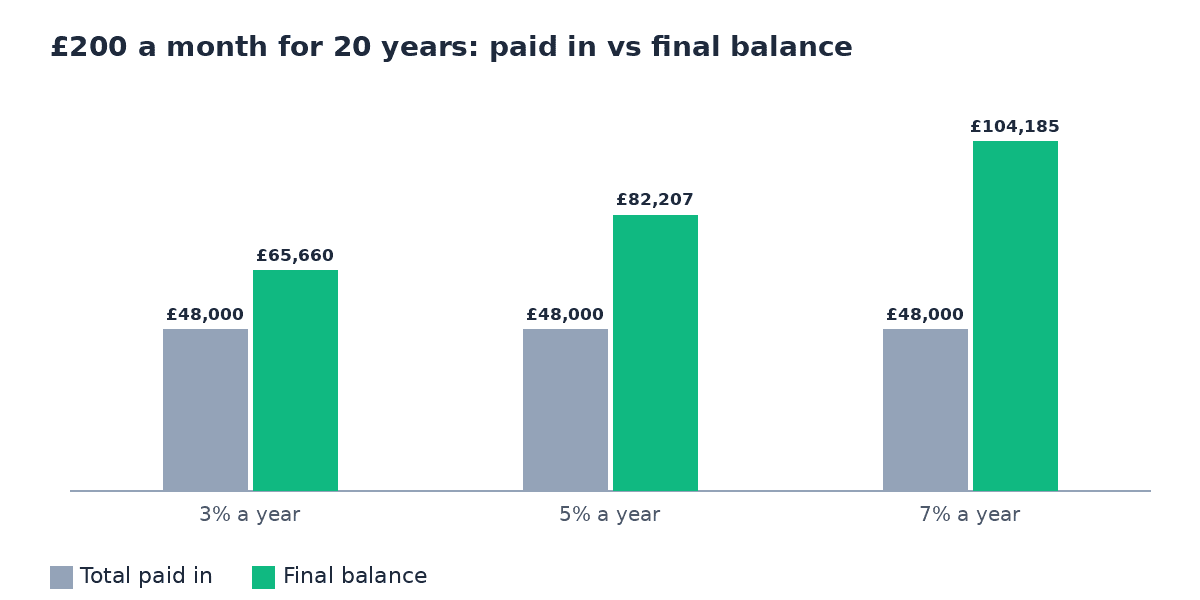
Compound interest means you earn interest on your earlier interest as well as on the money you paid in. Saving £200 a month at 7% a year for 20 years grows to £104,185, of which £48,000 is your own deposits and £56,185 is interest.
This guide shows the formula, a table of results at 3%, 5% and 7% over 10, 20 and 30 years, and two comparisons that explain why time matters more than almost anything else. The rates are examples, not forecasts, and every figure comes from the same engine as the compound interest calculator.
Contents
How does compound interest with monthly deposits work?#
Each month the balance earns interest at the monthly rate, and then your deposit is added at the end of the month. Next month’s interest is charged on the larger balance, so growth speeds up the longer you leave it.
Future value with a monthly deposit (deposits at the end of each month)
Balance = start × (1 + r)^n + deposit × ((1 + r)^n − 1) ÷ r
r = monthly rate (annual rate ÷ 12 when compounded monthly), n = number of months
The calculator uses the same monthly steps and shows the result year by year.
Worked example: £200 a month at 7% for 20 years
Assumptions: Starting balance £0; interest compounded monthly at 7% a year; deposits at the end of each month; no tax or fees.
- Total paid in: £200 × 240 months = £48,000.
- Final balance: £104,185.
- Interest earned: £104,185 − £48,000 = £56,185.
More than half of the final balance is growth you did not have to pay in.
£200 a month at 3%, 5% and 7%#
The table keeps the deposit at £200 a month and varies the rate and the time. The top row shows how much you pay in over each period.
| Annual rate | After 10 years | After 20 years | After 30 years |
|---|---|---|---|
| Amount paid in | £24,000 | £48,000 | £72,000 |
| 3% | £27,948 | £65,660 | £116,547 |
| 5% | £31,056 | £82,207 | £166,452 |
| 7% | £34,617 | £104,185 | £243,994 |
Figures are rounded to the nearest pound.
At 7% the balance after 30 years (£243,994) is about 2.3 times the 20-year balance, even though you only paid in 1.5 times as much. The last ten years do most of the work, because the balance they grow from is already large.
Why starting early beats saving longer#
Two savers each have 30 years. One pays £200 a month for the first 10 years and then stops. The other waits 10 years and then pays £200 a month for the next 20 years. Both earn 7%.
| Saver | Months of deposits | Total paid in | Balance after 30 years |
|---|---|---|---|
| Early: pays years 1–10, then stops | 120 | £24,000 | £139,809 |
| Late: waits 10 years, pays years 11–30 | 240 | £48,000 | £104,185 |
The early starter pays in half as much and ends with £35,624 more. The first ten years of deposits then have 20 more years to grow, which adds more than the extra ten years of deposits the late starter makes.
Worked example: £10,000 lump sum versus monthly deposits
Assumptions: 7% a year for 20 years, compounded monthly.
- £10,000 left alone for 20 years grows to £40,387.
- £10,000 plus £200 a month for 20 years grows to £144,573.
The lump sum is a good start, but regular deposits drive most of the result over long periods.
Does compounding frequency matter?#
Compounding monthly instead of yearly helps a little. £10,000 at 5% for 10 years grows to £16,289 with annual compounding and £16,470 with monthly compounding, a difference of about £181 on a 10-year investment.
The rate, the number of years and the size of the deposits matter much more. When comparing accounts, check the effective annual rate and any fees, not only how often interest is added.
How to run your own numbers#
Using the compound interest calculator
- Enter what you already have as the starting balance, or 0.
- Add the amount you can save each month and the number of years.
- Use a cautious rate. Higher rates assume more investment risk, and none is guaranteed.
- Try the same inputs at two or three rates to see the range, not one answer.
- Use the savings goal calculator instead if you start from a target amount and want to know the monthly deposit.
To start from a target rather than a deposit, use the savings goal calculator, which works backwards from the amount you want and the date you want it by.
Common mistakes#
Mistake: Using a high rate as if it were guaranteed.
Instead: Show the result at 3%, 5% and 7%. The gap between them is larger than most people expect.
Mistake: Ignoring inflation.
Instead: A balance of £104,185 in 20 years will buy less than it does today. Compare results with a lower rate to allow for it.
Mistake: Multiplying the monthly deposit by 12 and applying the yearly rate once.
Instead: Money paid in during the year earns less than a full year of interest. Use monthly steps, as the calculator does.
Mistake: Stopping deposits in a downturn without checking the numbers.
Instead: Missing early deposits costs more than missing late ones, because they have the longest to grow.
Try the tool
Compound Interest Calculator
Enter a starting balance, monthly deposit, rate and years to see the final balance, interest earned and a year-by-year chart.
Open the Compound Interest CalculatorFrequently asked questions#
How much will £200 a month grow to in 20 years?
It depends on the rate: £65,660 at 3%, £82,207 at 5% and £104,185 at 7%, on £48,000 of deposits, with interest compounded monthly and deposits at the end of each month.
What is the formula for compound interest with monthly contributions?
Balance = start × (1 + r)^n + deposit × ((1 + r)^n − 1) ÷ r, where r is the monthly rate and n the number of months. The first part grows your starting balance, the second grows the stream of deposits.
How long does it take to double my money at 7%?
About 10 years. The rule of 72 gives 72 ÷ 7 ≈ 10.3 years, and £10,000 at 7% compounded monthly reaches £20,097 after exactly 10 years.
Is it better to invest a lump sum or monthly?
A lump sum has more time to grow, so if you have the money it usually earns more than the same amount spread over months. In practice most people can only save monthly, and regular deposits still build the largest balances over long periods.
Does compounding monthly pay more than yearly?
Slightly. £10,000 at 5% for 10 years is £16,289 with yearly compounding and £16,470 with monthly. The extra from more frequent compounding is small compared with the effect of the rate and the time.
Do these examples include tax?
No. The calculator shows gross growth. Tax depends on the account type and your circumstances, so check the rules for the account you plan to use.
Ahad Noor
Ahad Noor builds and maintains Momentix, including its calculators, converters and the guides on this blog.
Each guide is checked against the matching Momentix tool, so the worked examples show the same figures the tool gives for the same inputs.