Dates & Time
How to Calculate Your Exact Age on Any Date
Work out an exact age in years, months and days from a date of birth, on today’s date or any past or future date, including leap-day birthdays.

Written by Ahad NoorPublished 8 min read
“How old are you?” is easy to answer in whole years, but forms, school admissions, insurance quotes and plain curiosity often need more: the exact age in years, months and days, or the age on a particular date rather than today.
This guide explains the counting method step by step, shows how to find an age on a past or future date, and covers the awkward cases: months of different lengths, birthdays on 29 February and why dividing a number of days by 365 can give the wrong answer.
Contents
How to calculate your age in years, months and days#
Work forwards from the date of birth to the date you are measuring to, in three steps.
- Whole years. Add years to the birth date for as long as you stay on or before the target date.
- Whole months. From that anniversary, add whole calendar months while you still stay on or before the target date.
- Days. Count the days left between that point and the target date.
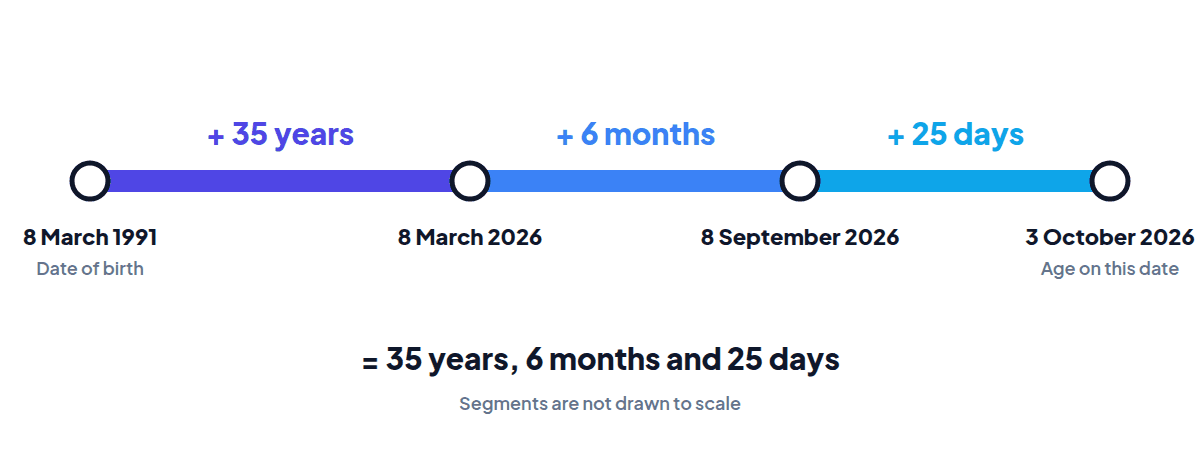
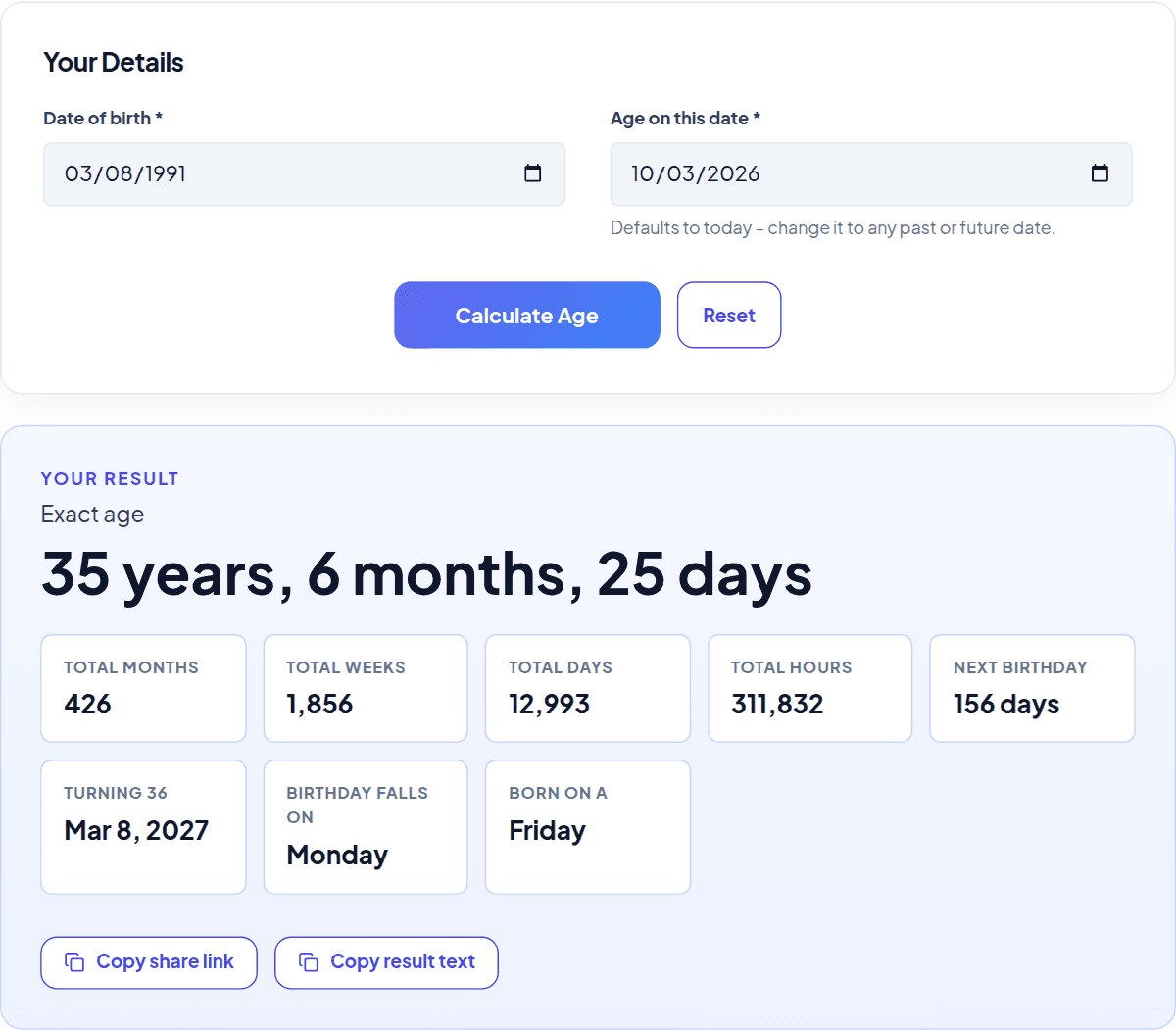
Worked example: born 8 March 1991, age on 3 October 2026
Assumptions: A fictional date of birth, measured to 3 October 2026. Calendar dates only; time of birth is ignored.
- 8 March 1991 + 35 years = 8 March 2026 (one more year would pass 3 October 2026).
- 8 March 2026 + 6 months = 8 September 2026 (a seventh month would reach 8 October, too far).
- 8 September to 3 October 2026 = 25 days.
35 years, 6 months and 25 days, which is 12,993 days in total.
Age on a past or future date#
The same method works for any target date, not only today. That answers questions such as how old someone was when a document was signed, or how old they will be on a trip, a retirement date or an application deadline.
| Age on | Exact age | Total days |
|---|---|---|
| 1 September 2009 (past) | 18 years, 5 months, 24 days | 6,752 |
| 3 October 2026 | 35 years, 6 months, 25 days | 12,993 |
| 1 January 2031 (future) | 39 years, 9 months, 24 days | 14,544 |
Why month lengths matter#
Months have 28, 29, 30 or 31 days, so “one month after the 31st” needs a rule. The Momentix age calculator uses the common one: if the target month is too short for the birth day, the last day of that month is used.
| Age on | Exact age | Why |
|---|---|---|
| 28 February 2026 | 26 years, 1 month, 0 days | February has no 31st, so 28 February completes the month |
| 1 March 2026 | 26 years, 1 month, 1 day | One day after that month-end |
| 31 March 2026 | 26 years, 2 months, 0 days | March has a 31st, so the second month completes exactly |
Other tools may count these month-end cases a day differently. Neither approach is wrong, but use one method consistently, especially when comparing results.
Birthdays on 29 February#
Someone born on 29 February has a real birthday only in leap years. In the other years two dates compete: 28 February and 1 March. Legal rules differ between countries, so if the answer matters for a licence, benefit or contract, check the rule that applies to it.
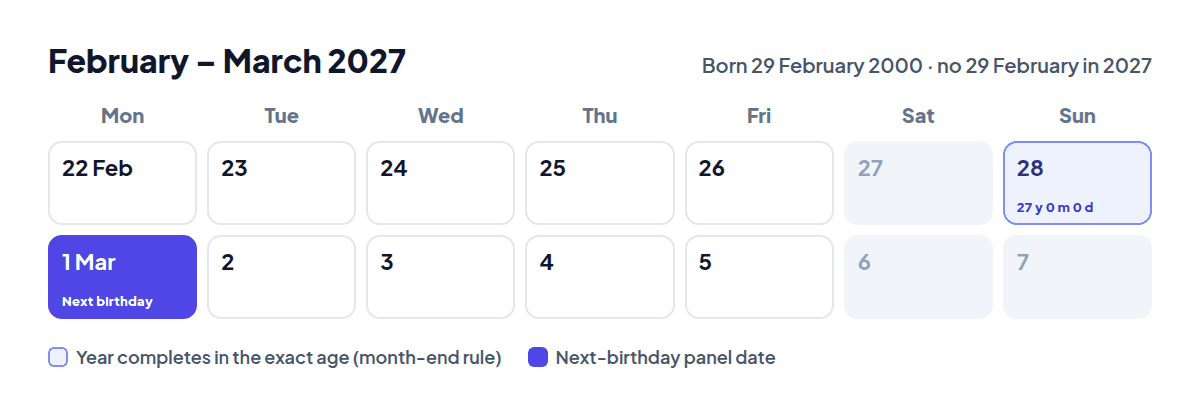
Worked example: born 29 February 2000
Assumptions: A fictional date of birth; results as shown by the Momentix age calculator.
- On 28 February 2027 the exact age reads 27 years, 0 months, 0 days, because the month-end rule completes the year on the last day of February.
- The next-birthday panel, however, shows the birthday on 1 March 2027, the date many countries observe in common years.
- On 1 March 2027 the age reads 27 years, 0 months, 1 day and the birthday shows as today; on 29 February 2028 it is exactly 28 years.
Completed age, age next birthday and “in your 36th year”#
The everyday age is the completed age: the number of birthdays already reached. Some documents use other forms, and they are easy to mix up.
| Form | Value | Where you see it |
|---|---|---|
| Completed age | 35 | Most forms, ID checks, everyday use |
| Age next birthday | 36 | Some insurance and pension quotes |
| Year of life | 36th year | Formal writing and some traditions |
Someone aged 35 is living through their 36th year, which is why “in your 36th year” sounds older than the completed age.
Why dividing days by 365 is only approximate#
A quick shortcut is to count the days since birth and divide by 365. It ignores leap years, so it drifts by about a quarter of a day each year, and near a birthday it can show the wrong whole number.
| Born | Age on | Days | Days ÷ 365 | Completed age |
|---|---|---|---|---|
| 8 March 1991 | 3 October 2026 | 12,993 | 35.597 | 35 |
| 15 November 2010 | 14 November 2026 | 5,843 | 16.008 | 15 |
| 31 December 1984 | 30 December 2026 | 15,339 | 42.025 | 41 |
In the second row the shortcut says 16, but the person turns 16 only the next day. Dividing by 365.25 helps on average but still fails on some dates, so count calendar years, months and days instead.
Total days, weeks and months lived#
Totals are handy for milestones such as a 10,000-day celebration or a baby’s age in weeks. For the 8 March 1991 example on 3 October 2026, the totals are 12,993 days, 1,856 full weeks, 426 full months and 311,832 hours (days × 24).
To measure the gap between any two dates that are not a birth date, for example a project start and end, the date difference calculator gives the same years, months and days breakdown. For working days only, use the business days calculator.
How to use the age calculator#
- Enter the date of birth.
- Leave “Age on this date” as today, or change it to any past or future date.
- Press Calculate Age to see the exact age, the totals, the next birthday and the weekday you were born on.
- Use “Copy share link” to send the same calculation to someone else.
Try the tool
Age Calculator
Enter a date of birth and any date to get the exact age, totals in days and weeks, and the next birthday.
Open the Age CalculatorCommon mistakes and edge cases#
Mistake: Subtracting birth years only: 2026 − 1991 = 35 for someone born on 8 March 1991, checked on 1 February 2026.
Instead: Check whether this year’s birthday has passed. It has not, so the completed age is 34.
Mistake: Using today’s date when a form asks for age on a cut-off date.
Instead: Enter the cut-off date as the “age on” date.
Mistake: Dividing days by 365 near a birthday.
Instead: Count calendar years, months and days.
Mistake: Assuming every tool treats 29 February the same way.
Instead: Check which convention the result uses, and the rule that applies to your purpose.
Edge case: an “age on” date before the birth date. The calculator stops with a message, because an age cannot be negative. Swap the dates or check for a typo in the year.
Before you write an age on a form
- Is the form asking for age today, or on a specific date?
- Does it want completed age or age next birthday?
- If the birthday is 29 February, which date does the rule use in common years?
- Have you double-checked the year of birth?
Frequently asked questions#
How do I find the date someone turns a particular age?
Add that many years to the date of birth. Someone born on 8 March 1991 turns 40 on 8 March 2031. The calculator’s next-birthday panel shows the next one and the age being reached; for later birthdays, put a date in that year in the “age on” box.
Can I work out an age on a historical date?
Yes, for any date on or after the date of birth, such as the age at a wedding or on the day a record was made. Dates are treated as modern Gregorian calendar dates, so very old records kept in another calendar may differ by some days.
Does the time of birth change the result?
No. The calculation uses calendar dates only, so the hour you were born and your time zone are not used. An age changes at the start of the birthday date.
Can I find my age on a date before today?
Yes, any date on or after the date of birth works. This is useful for finding how old someone was on the date of an event or a document.
Why does my age in months look one day different elsewhere?
Tools handle month-ends differently. Momentix uses the last day of a short month when the birth day does not exist in it, for example 28 February for someone born on 31 January.
Ahad Noor
Ahad Noor builds and maintains Momentix, including its calculators, converters and the guides on this blog.
Each guide is checked against the matching Momentix tool, so the worked examples show the same figures the tool gives for the same inputs.