Dates & Time
How Long Is 11 Business Days? Weekends, Holidays and Examples
11 business days is usually 15 calendar days, or 17 from a Friday. See examples from every weekday, a 1–15 day table, and how holidays change it.

Written by Ahad NoorPublished 11 min read
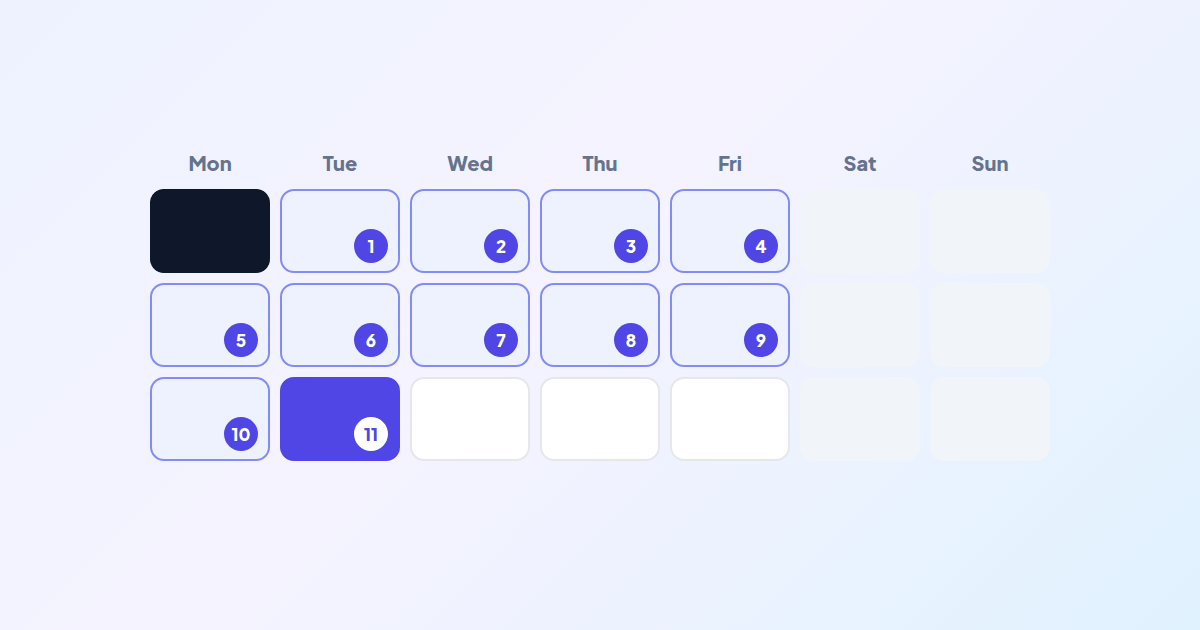
A delivery estimate, a refund window or a contract clause says “11 business days”, and you want to know the actual date. The short answer: with a Saturday and Sunday weekend and no public holidays, 11 business days is 15 calendar days when you start on a Monday to Thursday, and 17 calendar days when you start on a Friday.
This guide shows where those numbers come from, gives a ready-made table for 1 to 15 business days from each weekday, and explains how holidays, unusual weekends and the “does today count?” question change the answer.
Contents
How long is 11 business days in calendar days?#
Five business days make one working week, so 11 business days is two working weeks (10 days) plus one more day. Two working weeks always cover 14 calendar days, and the extra day adds one more calendar day, unless that extra day lands after a weekend.
| Start day | 11 business days later | Calendar days |
|---|---|---|
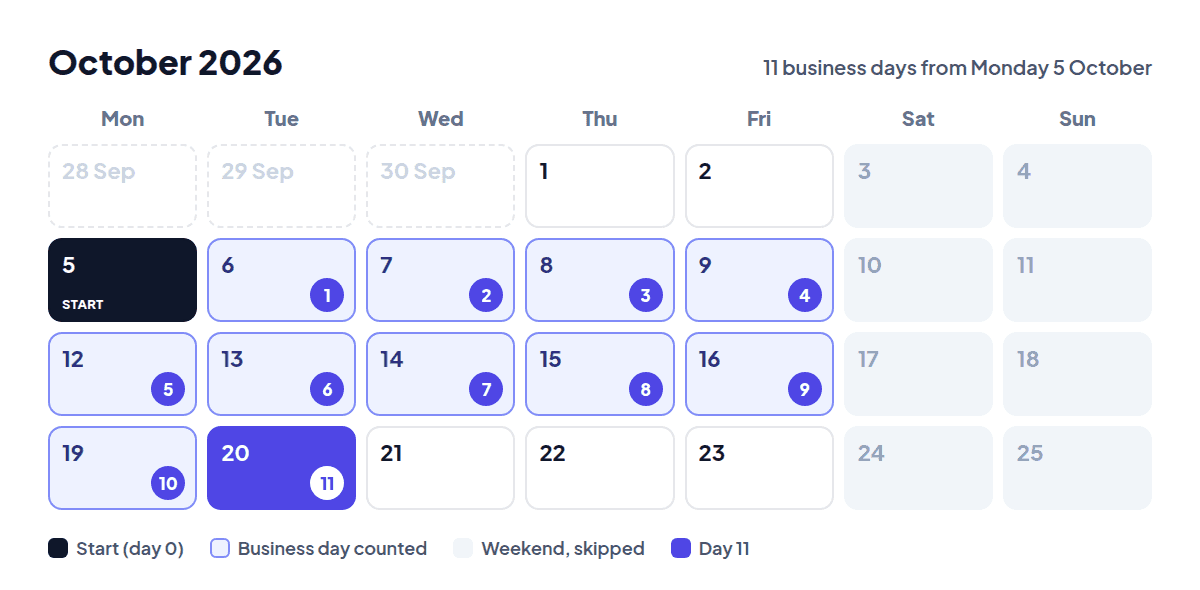
| Monday 5 October 2026 | Tuesday 20 October 2026 | 15 |
| Tuesday 6 October 2026 | Wednesday 21 October 2026 | 15 |
| Wednesday 7 October 2026 | Thursday 22 October 2026 | 15 |
| Thursday 8 October 2026 | Friday 23 October 2026 | 15 |
| Friday 9 October 2026 | Monday 26 October 2026 | 17 |
| Saturday 10 October 2026 | Monday 26 October 2026 | 16 |
| Sunday 11 October 2026 | Monday 26 October 2026 | 15 |
Notice the last three rows. If an order is placed on a Friday, Saturday or Sunday, the first business day counted is the following Monday, so all three reach the same end date: Monday 26 October.
Business days vs calendar days#
Calendar days are every day on the calendar, weekends and holidays included. Business days, also called working days or workdays, are the days an organisation is normally open: usually Monday to Friday, minus public holidays. A promise of “10 calendar days” and “10 business days” can be almost a week apart.
| Business days | Calendar days | Plain-English length |
|---|---|---|
| 5 | 7 | One week |
| 10 | 14 | Two weeks |
| 11 | 15 | Two weeks and one day |
| 15 | 21 | Three weeks |
The 5, 10 and 15 rows are the same from every weekday, because a whole number of working weeks always spans whole calendar weeks. Counts that are not a multiple of five, such as 11, depend on the day you start.
The difference matters when you set terms yourself. If you write payment terms on an invoice, for example with the invoice generator, say whether “14 days” means business days or calendar days.
Does the start day count as a business day?#
There are two different questions here, and the convention differs for each.
- Adding business days to a date (“11 business days from Monday”): the start day is day zero. Counting begins on the next working day, so 1 business day from Monday is Tuesday. This is how most delivery and response times are read.
- Counting business days between two dates (“how many working days from the 5th to the 20th?”): the start date counts if it is a working day, and the end date counts only if you choose to include it.
Worked example: the same two dates, two answers
Assumptions: Saturday–Sunday weekend, no holidays.
- Between Monday 5 October 2026 and Tuesday 20 October 2026, end date excluded: 15 calendar days − 4 weekend days = 11 business days.
- The same range with the end date included: 16 calendar days − 4 weekend days = 12 business days.
If a contract counts both the first and the last day, include the end date. If it says “within 11 business days of the 5th”, use the adding method instead.
Business days from today: a 1 to 15 day table#
Find the number of business days in the left column and the day you start along the top. Each cell shows the weekday you land on and, in brackets, how many calendar days later that is.
| Business days | From Monday | From Tuesday | From Wednesday | From Thursday | From Friday |
|---|---|---|---|---|---|
| 1 | Tue (+1) | Wed (+1) | Thu (+1) | Fri (+1) | Mon (+3) |
| 2 | Wed (+2) | Thu (+2) | Fri (+2) | Mon (+4) | Tue (+4) |
| 3 | Thu (+3) | Fri (+3) | Mon (+5) | Tue (+5) | Wed (+5) |
| 4 | Fri (+4) | Mon (+6) | Tue (+6) | Wed (+6) | Thu (+6) |
| 5 | Mon (+7) | Tue (+7) | Wed (+7) | Thu (+7) | Fri (+7) |
| 6 | Tue (+8) | Wed (+8) | Thu (+8) | Fri (+8) | Mon (+10) |
| 7 | Wed (+9) | Thu (+9) | Fri (+9) | Mon (+11) | Tue (+11) |
| 8 | Thu (+10) | Fri (+10) | Mon (+12) | Tue (+12) | Wed (+12) |
| 9 | Fri (+11) | Mon (+13) | Tue (+13) | Wed (+13) | Thu (+13) |
| 10 | Mon (+14) | Tue (+14) | Wed (+14) | Thu (+14) | Fri (+14) |
| 11 | Tue (+15) | Wed (+15) | Thu (+15) | Fri (+15) | Mon (+17) |
| 12 | Wed (+16) | Thu (+16) | Fri (+16) | Mon (+18) | Tue (+18) |
| 13 | Thu (+17) | Fri (+17) | Mon (+19) | Tue (+19) | Wed (+19) |
| 14 | Fri (+18) | Mon (+20) | Tue (+20) | Wed (+20) | Thu (+20) |
| 15 | Mon (+21) | Tue (+21) | Wed (+21) | Thu (+21) | Fri (+21) |
The table is built for a normal week. If a public holiday falls inside your range, move one working day later for each holiday.
What is 2 business days from today?#
From a Monday it is Wednesday, and from a Tuesday or Wednesday it is two days later. From a Thursday it is the next Monday (4 calendar days), and from a Friday it is the next Tuesday. An order placed on Thursday 8 October 2026 with 2-business-day handling ships on Monday 12 October; one placed on Friday 9 October ships on Tuesday 13 October.
How long is 2 to 7 business days?#
A “2 to 7 business days” delivery window covers 2 to 4 calendar days at the early end and 9 to 11 calendar days at the late end, depending on the day you order. Ordered on Friday 9 October 2026, for example, the parcel could arrive any time from Tuesday 13 October to Tuesday 20 October.
How to calculate business days between two dates#
- Count the calendar days in the range, deciding first whether the end date is included.
- Subtract the weekend days inside that range.
- Subtract each public holiday that falls on a working day. A holiday on a Saturday or Sunday is already excluded, so do not subtract it twice.
Worked example: working days in October 2026
Assumptions: Saturday–Sunday weekend, no holidays, both 1 and 31 October included.
- 31 calendar days − 9 weekend days = 22 business days.
- From Thursday 1 to Friday 30 October with the end date excluded, the count is 21; including the 30th makes it 22.
For longer ranges, a shortcut helps: each full week contributes exactly five business days, so only the leftover days at the end need counting by hand. The date difference calculator gives the total calendar days if you want to check that part separately.
When the weekend isn’t Saturday and Sunday#
Not every workplace rests on Saturday and Sunday. In several countries the working week runs Sunday to Thursday, and some businesses work six days a week. The business days calculator lets you tick any combination of days as the weekend.
| Weekend | Result | Calendar days |
|---|---|---|
| Saturday and Sunday | Tuesday 20 October | 15 |
| Friday and Saturday | Tuesday 20 October | 15 |
| Sunday only (six-day week) | Saturday 17 October | 12 |
With a Friday–Saturday weekend the result from a Monday happens to match the usual one, but the days in between differ: Friday is skipped and Sunday is worked. Starting from Sunday 4 October, 11 business days with a Friday–Saturday weekend ends on Monday 19 October.
How public holidays change the count#
Public holidays are set by country, and often by region. England and Wales, Scotland and Northern Ireland each have their own list of bank holidays, and the dates move from year to year. Always add the holidays that apply to the business doing the work, not to you as the customer.
Worked example: 11 business days over Christmas
Assumptions: Saturday–Sunday weekend; England and Wales bank holidays on Friday 25 December 2026, Monday 28 December 2026 (Boxing Day, moved from Saturday) and Friday 1 January 2027, as listed on GOV.UK.
- Without holidays, 11 business days from Friday 18 December 2026 is Monday 4 January 2027 (17 calendar days).
- With the three bank holidays added, the same count ends on Thursday 7 January 2027 (20 calendar days).
Three holidays on working days push the end date back by three working days.
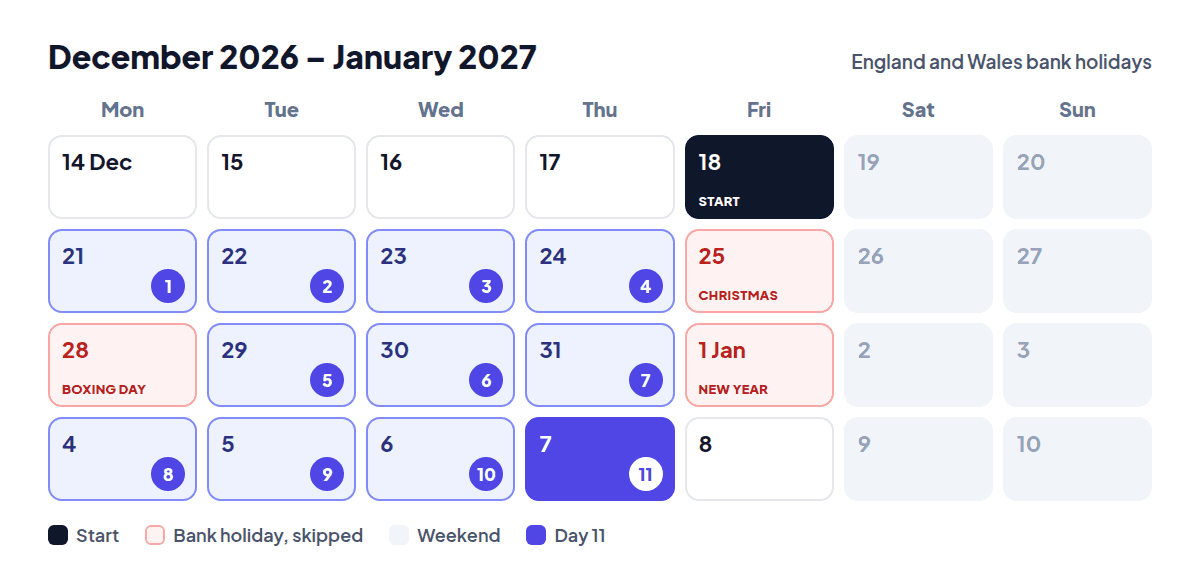
Adding Saturday 26 December to the holiday list as well changes nothing: it is already a weekend day, and the calculator never removes a day twice.
Counting business days backwards from a deadline#
Sometimes you know the deadline and need the start date, for example the last day to post a notice that must arrive 11 business days before a meeting. Enter a negative number in the calculator to count backwards: 11 business days before Tuesday 20 October 2026 is Monday 5 October 2026.
How to use the business days calculator#
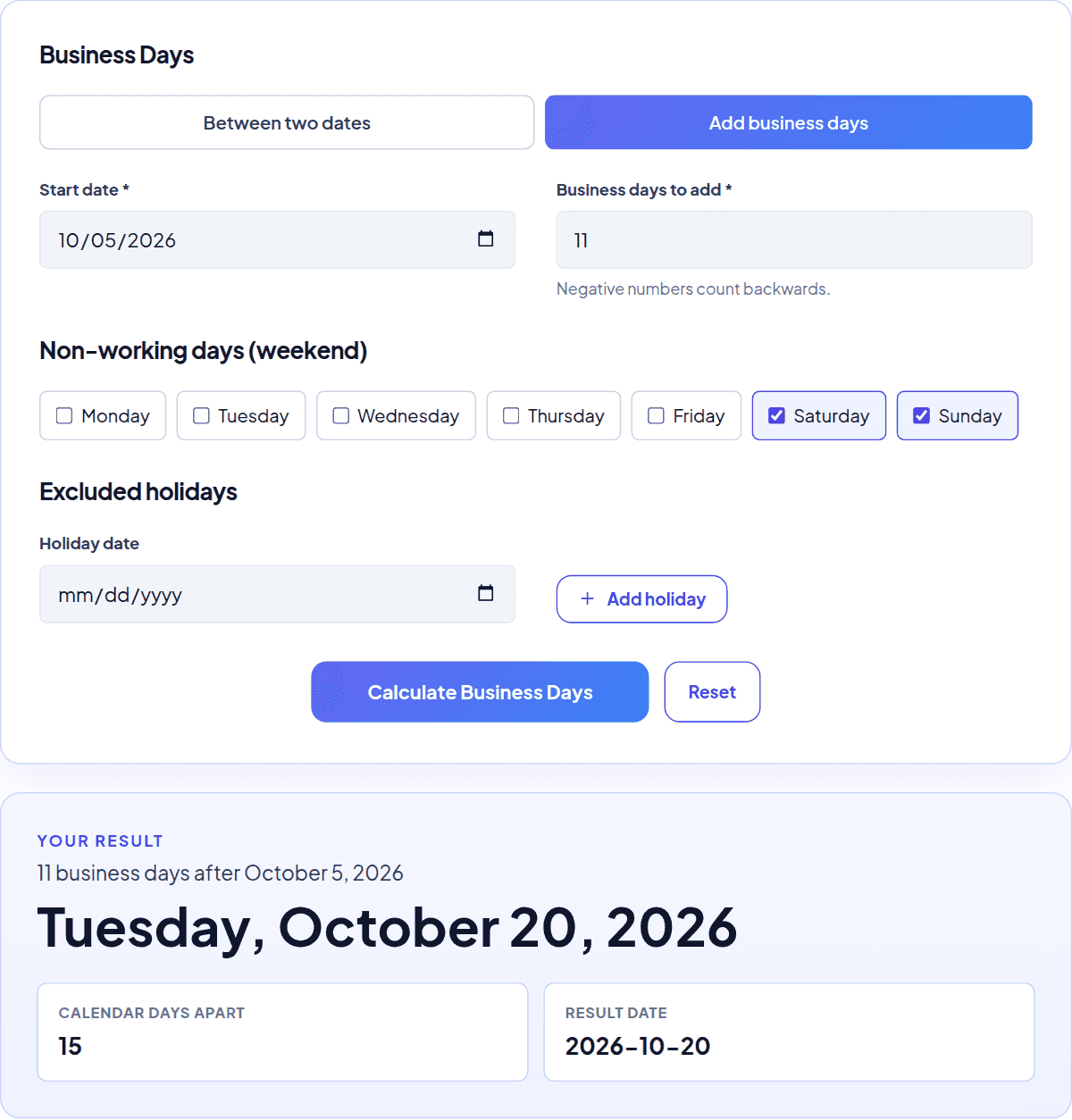
- Choose Add business days to find an end date, or Between two dates to count working days in a range.
- Enter the start date (it fills in today’s date for you) and the number of days or the end date.
- Tick the days that count as your weekend. Saturday and Sunday are ticked by default.
- Add any public holidays, one date at a time, then press Calculate.
Try the tool
Business Days Calculator
Add or count working days between any two dates, with your own weekend and holiday list.
Open the Business Days CalculatorCommon mistakes and edge cases#
Mistake: Counting the order day as day 1.
Instead: When adding business days, day 1 is the next working day. 1 business day from Monday is Tuesday.
Mistake: Treating 11 business days as 11 calendar days.
Instead: Allow for the weekends: usually 15 calendar days, 17 from a Friday.
Mistake: Using your own country’s holidays for an overseas supplier.
Instead: Use the holidays where the work happens, such as the courier’s or the bank’s country.
Mistake: Subtracting a holiday that falls on a weekend.
Instead: Only holidays on working days reduce the count.
Edge case: starting on a weekend. If the start date is a Saturday or Sunday, nothing is counted until Monday. That is why 11 business days from Saturday 10 October and from Sunday 11 October both end on Monday 26 October, 16 and 15 calendar days later.
Quick checklist before you rely on a business-day date
- Is the start day counted, or does counting begin the next working day?
- Which days are the weekend for the business involved?
- Have you added every public holiday that falls on a working day in the range?
- If counting between dates, should the end date be included?
Frequently asked questions#
Is Saturday a business day?
Usually not. Most organisations treat Monday to Friday as business days, so Saturday and Sunday are skipped. Some businesses do work on Saturdays; if yours does, untick Saturday as a weekend day in the calculator and it will be counted.
How many calendar days is 10 business days?
Exactly 14 calendar days from any weekday when there are no holidays, because 10 business days is two full working weeks. From Monday 5 October 2026, 10 business days later is Monday 19 October.
How many business days are in a month?
Between 20 and 23, depending on the month and where its weekends fall, before public holidays are taken off. October 2026 has 22, November 2026 has 21 and February 2027 has 20 with a Saturday–Sunday weekend.
Are bank holidays counted as business days?
No. A bank or public holiday on a weekday is a non-working day, so it is skipped like a weekend. Add each one to the calculator’s holiday list so the result moves back by the right number of days.
Does “within 11 business days” include the day the request was made?
Normally not. The request day is day zero and the period starts on the next working day. If the wording is unclear, check the terms of the company or contract concerned.
Sources
- GOV.UK – UK bank holidays (checked 3 October 2026)
Ahad Noor
Ahad Noor builds and maintains Momentix, including its calculators, converters and the guides on this blog.
Each guide is checked against the matching Momentix tool, so the worked examples show the same figures the tool gives for the same inputs.